
A sleeve that fits a wire on the bench may be difficult to install after the terminal has been crimped. It may also sit next to a motor winding, a hot appliance part or a sharp metal edge. Those details affect the sleeve you order. For electrical wiring, the useful starting point is the finished assembly and its working conditions, rather than a diameter and a temperature number alone.
BSTFLEX's HTG fiberglass sleeve is braided from non-alkali E-glass yarn, heat treated and impregnated with a flexible resin. The product page lists it for insulation and mechanical protection of wiring in electrical machinery, motors and domestic appliances. The notes below show how to turn that description into an actionable purchase specification.
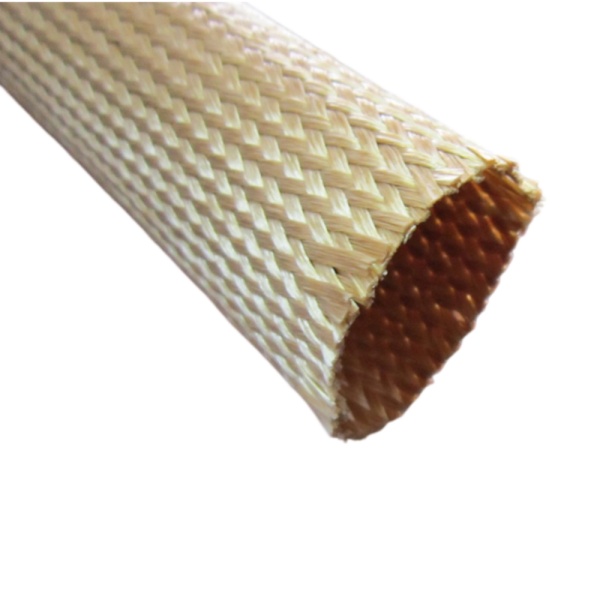
Measure the largest outside diameter that the sleeve must pass over, including insulation, splices, joints and any connector that cannot be fitted later. Record the required covered length and where the sleeve ends will sit. If installation involves pulling through a housing or around a bend, trial a sample on the real route. A nominal wire size does not describe a finished harness.
The HTG product page lists nominal inner diameters from 0.5 mm to 30 mm, with different diameter tolerances and wall thickness ranges by size. State the required nominal bore and check the tolerance for that size against both the largest installation feature and the minimum diameter needed for a snug fit. For repeated production, specify the finished cut length and how much variation your assembly can accept.
Give the supplier the normal temperature at the sleeve location, the duration of that exposure and any short events such as startup or a fault condition. The HTG listing states an operating range of -30°C to 350°C and short peaks at 400°C. It also lists thermal class C. These are the published product figures; they do not establish the temperature rating of the complete wire or appliance assembly. The conductor insulation, nearby parts and approval requirements still need their own review.
Where the sleeve touches a hot component, include a sketch or photo showing the contact point. Where heat comes from a nearby surface instead, note the gap, airflow and any shield already in place. This helps distinguish a local contact problem from general ambient heat in the enclosure.
The product page gives a breakdown voltage range of 0.5 kV to 1.5 kV. Ask which result applies to the diameter and construction being quoted, and request the test method and conditions. A range on a product page should not be treated as the rating of every sleeve size or as a substitute for testing the installed wiring system.
For motor leads and appliance wiring, also tell the supplier whether the sleeve is an added protective layer over an already insulated conductor or part of the insulation system you are qualifying. That distinction determines what documentation your engineering team will need. If a particular standard or customer test is mandatory, send its exact designation with the inquiry.
HTG is a resin-impregnated glass braid. The finish is part of the product specification, so include any winding varnish, potting compound, adhesive, cleaning agent or processing heat used after sleeving. Check compatibility with your actual process and inspect a sample after cutting, threading and final assembly. If your process requires a different surface or a separate coating, discuss that before ordering production lengths.
A silicone rubber outer layer is a separate construction. For a requirement that specifically calls for silicone coated sleeving, see the silicone rubber coated fiberglass sleeving product and compare its stated properties and test data against the HTG version. The two should have separate specifications and search terms.
A short technical brief saves more time than a long list of general keywords. Include the following:
BSTFLEX lists black and light brown as standard colours, with other colours on request. Its product page also gives size-dependent roll lengths, so confirm the exact spool length and packing for the selected diameter. Send the completed brief through the HTG fiberglass sleeve product page to request a matching sample and quotation.

 français
 Deutsch
 русский
 italiano
 español
 português
 Nederlands
 العربية
 日本語
 한국의
 Türkçe
 Polski
 Tiếng Việt
 slovenský
 Indonesia