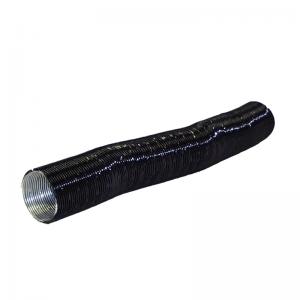
Using a stainless steel spring hose guard (also known as a spring guard or coil guard) for a hydraulic hose is a protective measure to significantly extend the hose's life and enhance safety in challenging environments.

Here’s a detailed breakdown of why they are used:
This is the most common and critical purpose. Hydraulic hoses are often routed near or against other components like frames, other hoses, brackets, or moving parts.
The Problem: Constant rubbing (chafing) wears away the hose's tough outer cover. Once this cover is compromised, the reinforcing wire braid is exposed and can quickly fail, leading to a burst hose.
The Solution: The stainless steel spring acts as a sacrificial shield. It takes the abrasive wear instead of the hose itself. The hard, smooth surface of the steel spring deflects abrasion, protecting the vulnerable rubber and wire beneath.
Hoses can get pinched between mechanical parts (e.g., between a cylinder and its mount) or crushed by heavy objects during operation or maintenance.
The Problem: A sharp pinch or crush can kink or flatten the hose, blocking flow and creating a stress point that will eventually fail.
The Solution: The rigid coil structure of the spring guard provides a strong, circular cage around the hose. It distributes the crushing force and prevents the hose from being deformed beyond its limits, maintaining the open flow path.
Hydraulic systems generate significant heat, and hoses are often routed near hot components like manifolds, valves, or exhaust systems.
The Problem: Excessive heat accelerates the aging of the rubber compounds in the hose, making them brittle and leading to cracks and failures.
The Solution: The stainless steel spring creates an air gap between the hot surface and the hose, acting as a heat sink and radiant heat shield. This lowers the temperature the hose is exposed to, prolonging its life.
A burst hydraulic hose is extremely dangerous. Hydraulic fluid can be injected into the skin (a serious medical emergency), and the high-pressure spray can cause injuries or ignite a fire if it hits a hot surface.
The Solution: While not designed to contain a full high-pressure burst, a spring guard can contain the initial whip of a failing hose and mitigate the spray, providing a crucial layer of operator safety. It acts as a first line of defense.
The hose's outer cover can be degraded by exposure to chemicals, solvents, saltwater, or extreme weather (UV rays, ozone).
The Solution: The stainless steel (typically 304 or 316 for high corrosion resistance) guard provides a physical barrier against these environmental and chemical attacks.
The Problem: Frequent hose failures lead to high replacement costs and, more importantly, costly machine downtime that halts entire operations.
The Solution: A relatively inexpensive spring guard can multiply the lifespan of a much more expensive hydraulic hose assembly. Preventing a single failure often pays for the guards on an entire machine by avoiding downtime and repair costs.
You will typically find stainless steel spring guards in applications where hoses are exposed to extreme abuse:
Heavy Equipment: Excavators, bulldozers, loaders (especially on boom and stick hoses).
Industrial Machinery: Injection molding machines, metal presses, steel mills.
Mobile Hydraulics: Agricultural and forestry equipment.
Marine and Offshore Applications: Where saltwater corrosion and abrasion are constant threats.
Anywhere a hose is routed through a "wear zone" identified by maintenance personnel.
Not for Every Hose: They are not needed on every hose in a system. They are a targeted solution for hoses in high-risk locations.
Proper Sizing: The spring guard's inner diameter must be correctly matched to the hose's outer diameter to ensure it provides protection without being too loose or too tight.
Installation: They are slid onto the hose before the end fittings are crimped on. They cannot be installed on a pre-made assembly.
In summary, a stainless steel spring hose guard is a simple, robust, and cost-effective insurance policy. It protects a critical component (the hydraulic hose) from the most common causes of failure—abrasion, crushing, and heat—thereby enhancing safety, reducing downtime, and saving money in the long run.

 français
 Deutsch
 русский
 italiano
 español
 português
 Nederlands
 العربية
 日本語
日本語 한국의
한국의 Türkçe
 Polski
 Tiếng Việt
 slovenský
 Indonesia