français
 Deutsch
 русский
 italiano
 español
 português
 Nederlands
 العربية
 日本語
日本語 한국의
한국의 Türkçe
 Polski
 Tiếng Việt
 slovenský
 Indonesia



How to Choose a Removable Insulation Cover for Industrial Filters
Industrial filters, basket strainers, Y-strainers, cartridge filter housings, and process filtration vessels are often installed in steam lines, hot oil systems, chemical processing plants, food production lines, marine engine rooms, and power generation equipment. When these filter housings operate at elevated temperatures, a removable insulation cover helps reduce heat loss, improve personnel protection, and keep the equipment accessible for inspection or maintenance.
Choosing the right removable insulation cover for an industrial filter is not only about selecting a high-temperature fabric. The cover must match the filter shape, working temperature, maintenance frequency, flange layout, pipe connection, installation environment, and fastening method. A well-designed cover should provide reliable thermal insulation while allowing operators to remove and reinstall it quickly when the filter element needs cleaning or replacement.
1. Confirm the Operating Temperature
The first step is to confirm the continuous operating temperature of the filter housing and the possible peak temperature during system start-up, shutdown, or abnormal working conditions. A steam filter, hot oil filter, exhaust filter, or chemical filtration vessel may require different insulation materials depending on the actual surface temperature.
For moderate-temperature applications, fiberglass insulation materials are commonly used. For higher-temperature service, silica insulation, ceramic fiber insulation, stainless steel mesh reinforcement, or other specialized materials may be required. The outer fabric should also be selected according to heat exposure, abrasion, oil mist, water splash, and outdoor weather conditions.
2. Check the Filter Housing Shape and Access Points
Industrial filters are rarely simple straight components. A filter housing may include a removable cover, bolted flange, clamp band, drain port, vent connection, pressure gauge, support bracket, lifting handle, inlet pipe, outlet pipe, and irregular body transition. These details must be considered before the insulation cover is produced.
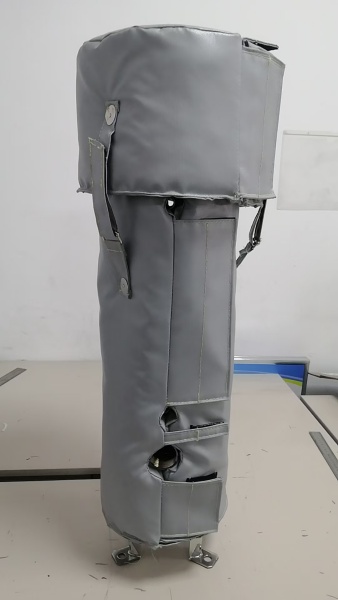
A good removable filter insulation cover should be custom shaped around the real equipment geometry. It should include accurate cut-outs or split sections for pipe connections, gauges, drains, bolts, handles, and brackets. If these details are not considered, the cover may be difficult to install or may block routine maintenance points.
3. Select the Right Outer Fabric
The outer layer protects the insulation core from the working environment. It should be selected according to the installation condition of the filter housing.
| Outer Fabric Option | Typical Use |
|---|---|
| Fiberglass Fabric | General industrial insulation covers for indoor equipment and standard heat protection applications |
| Silicone Coated Fiberglass Fabric | Applications requiring better abrasion resistance, water resistance, oil resistance, and flexible handling |
| PTFE Coated Fiberglass Fabric | Chemical processing, food equipment, and environments requiring a smoother, more chemical-resistant surface |
| Aluminum Foil Fiberglass Fabric | Applications requiring radiant heat reflection and a clean metallic surface |
| Stainless Steel Mesh Reinforced Fabric | Heavy-duty industrial areas where abrasion, mechanical wear, or repeated handling is expected |
4. Choose the Correct Insulation Core
The insulation core determines the thermal performance of the removable cover. The required thickness and material depend on the filter surface temperature, heat retention target, safety requirement, and available installation space.
Fiberglass insulation mat is suitable for many general industrial applications. Silica insulation mat or ceramic fiber insulation mat can be selected for higher-temperature systems. In some projects, a multi-layer structure is used to improve insulation performance while keeping the cover flexible enough for removal and reinstallation.
If the customer has a target outer surface temperature, this information should be provided before production. It helps the manufacturer recommend a suitable insulation thickness and material combination.
5. Decide the Fastening Method
The fastening system affects installation speed, durability, and maintenance convenience. For filters that are opened frequently, the closure method should be easy to operate and strong enough for repeated use.
| Fastening Method | Suitable Application |
|---|---|
| Hook-and-Loop Closure | Quick installation and removal on lower-risk or moderate-temperature sections |
| Stainless Steel Buckles | Heavy-duty industrial covers requiring secure mechanical fixing |
| Straps and D-Rings | Adjustable closure for irregular filter housings or equipment with complex shapes |
| Snap Fasteners | Clean and repeatable closure for small or medium-size covers |
| Wire Lacing | High-temperature or vibration-prone areas where metal fastening is preferred |
6. Consider Indoor, Outdoor, and Chemical Exposure
The same filter insulation cover may perform differently in different environments. Indoor steam systems may only require heat retention and personnel protection. Outdoor installations may need moisture resistance, UV resistance, reinforced stitching, stainless steel hardware, and weather-resistant outer fabric.
For chemical plants, oil refineries, food processing lines, and marine applications, the cover may be exposed to chemicals, oils, salt spray, cleaning liquids, or wash-down conditions. In these cases, silicone coated fiberglass fabric, PTFE coated fiberglass fabric, aluminum foil facing, or stainless steel mesh reinforcement may be considered according to the working environment.
7. Make Sure the Cover Allows Maintenance Access
The main advantage of a removable insulation cover is maintenance access. Before confirming the design, check how the filter is opened, which parts must remain visible, and which components need regular operation.
- Does the filter cover or lid need to be opened frequently?
- Is the pressure gauge required to remain visible?
- Are drain and vent ports operated during service?
- Do bolts or clamps need clearance?
- Does the cover need to be removed as one piece or multiple sections?
- Should the inlet and outlet pipes also be insulated?
Answering these questions before production helps prevent installation problems and improves the long-term usability of the insulation cover.
8. Provide Accurate Measurements Before Production
Since industrial filters are often customized by different equipment manufacturers, accurate measurement is critical. A removable insulation cover can be produced according to technical drawings, field measurements, equipment photos, sample covers, or detailed measurement sheets.
| Required Information | Why It Matters |
|---|---|
| Filter body length and diameter | Determines the main cover size and insulation coverage area |
| Inlet and outlet pipe position | Ensures accurate cut-outs and correct installation direction |
| Flange size and bolt clearance | Prevents interference with bolted connections and service points |
| Gauge, drain, vent, and handle position | Allows important components to remain accessible |
| Operating temperature | Helps select suitable fabric, insulation core, thread, and fastening material |
| Installation environment | Helps determine whether moisture, oil, chemical, or abrasion resistance is required |
9. Choose a Manufacturer with Custom Fabrication Experience
A removable filter insulation cover is not a standard flat blanket. It requires pattern design, material selection, sewing, reinforcement, hardware placement, and a clear understanding of how industrial equipment is maintained in real working conditions.
When choosing a supplier, check whether they can work from drawings, photos, samples, and measurement sheets. Also confirm whether they can provide different material options for temperature, abrasion, oil exposure, outdoor installation, and repeated handling.
Custom Removable Filter Insulation Covers from BSTFLEX
BSTFLEX manufactures custom removable insulation covers for industrial filter housings, basket strainers, Y-strainers, cartridge filters, steam systems, hot oil systems, chemical process equipment, marine piping, and OEM machinery. Covers can be customized with fiberglass fabric, silicone coated fiberglass fabric, PTFE coated fiberglass fabric, aluminum foil fiberglass fabric, stainless steel mesh, silica insulation, ceramic fiber insulation, stainless steel buckles, straps, hook-and-loop closures, and wire lacing.
For filter housings that require heat retention, surface temperature reduction, and easy maintenance access, our Custom Removable Filter Insulation Cover can be made according to your drawings, equipment photos, dimensions, samples, or project requirements.
FAQ
What is the most important factor when choosing a removable filter insulation cover?
The most important factors are operating temperature, filter housing shape, maintenance access, insulation thickness, outer fabric selection, and fastening method. The cover must fit the real equipment structure and remain easy to remove during service.
Can one insulation cover fit different filter models?
Usually not. Industrial filter housings often have different diameters, lengths, flanges, ports, gauges, drains, and pipe layouts. A custom-made cover provides a better fit and better maintenance access.
Which outer fabric is best for outdoor filter insulation covers?
Silicone coated fiberglass fabric, PTFE coated fiberglass fabric, aluminum foil fiberglass fabric, or stainless steel mesh reinforced fabric may be selected depending on moisture, abrasion, chemical exposure, and weather conditions.
Can the insulation cover be removed frequently?
Yes. The cover can be designed with hook-and-loop tape, buckles, straps, D-rings, snap fasteners, or wire lacing for repeated removal and reinstallation.
What information should I provide for a quotation?
Provide the filter housing diameter, length, pipe connection position, flange size, gauge and drain location, operating temperature, installation environment, photos, drawings, or samples.