Fiberglass mat is a broad category of nonwoven glass fiber reinforcements widely used in composite and FRP manufacturing. Within this category, different mat structures are developed to meet specific processing and performance requirements.
e-glass needle mat is one of the most commonly used fiberglass mats, but it is not the only option. Other fiberglass mat types—such as chopped strand mat and stitched mat—are also widely applied depending on application needs.
Understanding the structural differences between these fiberglass mats is essential for selecting the right reinforcement material.
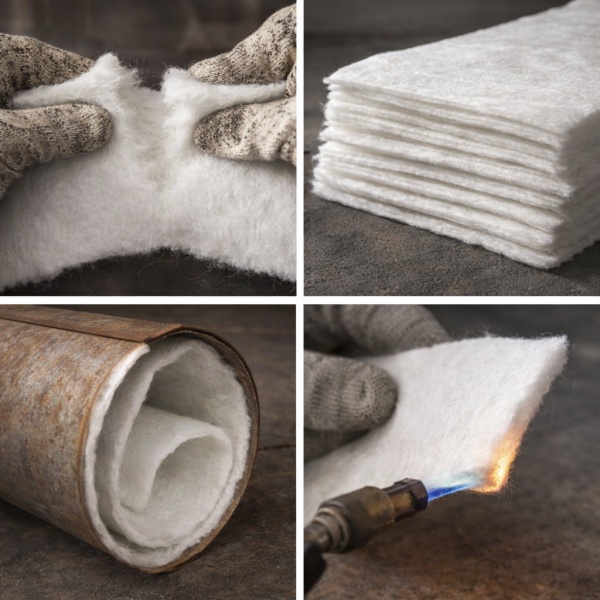
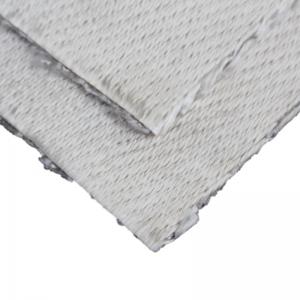
e-glass needle mat is a needle-punched fiberglass mat produced from E-glass fibers. Instead of relying primarily on chemical binders, fibers are mechanically interlocked through a needle-punching process.
This structure gives e-glass needle mat several distinguishing characteristics:
High flexibility and drapeability
Uniform thickness across large areas
Broad resin compatibility
Stable handling during lay-up and molding
Within the fiberglass mat family, these properties make needle mat especially suitable for complex shapes and consistent laminates.
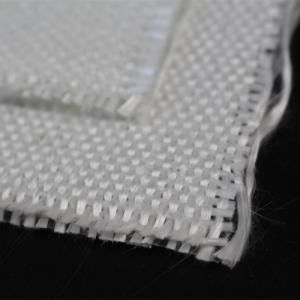
Chopped strand mat is made from randomly distributed short glass fibers bonded together with chemical binders.
Typical features:
Cost-effective for simple laminates
Widely used in basic FRP applications
Resin compatibility depends on binder type
Stitched mat consists of continuous or chopped fibers stitched together with yarn.
Typical features:
Higher directional strength
Lower flexibility compared to needle mat
Requires controlled orientation during processing
This type uses continuous glass filaments laid into a mat structure.
Typical features:
Good tensile strength
Less conformable on complex molds
Often used in flat or semi-structural products
e-glass needle mat: mechanical fiber entanglement
Chopped strand mat: chemical binder bonding
Mechanical bonding improves flexibility and reduces resin restrictions, while chemical binders may limit resin choice and affect wet-out speed.
Uniform thickness is critical for surface quality and mechanical reliability.
e-glass needle mat offers excellent thickness consistency
Chopped strand mat may show variation due to binder distribution
Stitched mat thickness can vary based on stitch pattern
For complex geometries:
e-glass needle mat conforms easily to curves and corners
Chopped strand mat may crack during shaping
Stitched mat can resist bending
Efficient resin wet-out reduces voids and defects.
e-glass needle mat allows smooth resin penetration
Chopped strand mat requires binder dissolution
Stitched mat may restrict resin flow at stitch points
Needle mat ensures uniform thickness
Chopped strand mat suits cost-sensitive products
e-glass needle mat performs best due to flexibility
Stitched mat may be difficult to conform
Needle mat offers stable processing behavior
Continuous filament mats may be too stiff for complex shapes
While chopped strand fiberglass mat may appear less expensive per kilogram, total production cost should consider:
Scrap rate
Processing speed
Rework frequency
In many cases, e-glass needle mat reduces overall manufacturing cost by improving yield and consistency.
| Fiberglass Mat Type | Resin Compatibility |
|---|---|
| e-glass needle mat | Polyester, vinyl ester, epoxy |
| Chopped strand mat | Binder-dependent |
| Stitched mat | Generally compatible |
| Continuous filament mat | Compatible |
The broad resin compatibility of e-glass needle mat simplifies material selection.
e-glass needle mat is often selected when:
Complex mold geometry is involved
Surface quality is critical
Consistent laminate thickness is required
Multiple resin systems are used
Other fiberglass mat types may be appropriate when:
Cost is the primary concern (chopped strand mat)
Directional strength is required (stitched mat)
Flat products dominate production (continuous filament mat)
Before selecting a fiberglass mat, consider:
Product geometry
Resin system
Required mechanical properties
Production stability
This structured evaluation helps align material choice with manufacturing goals.
By understanding how e-glass needle mat compares with other types of fiberglass mat, manufacturers can make informed material selections that balance performance, cost, and production efficiency.

 français
 Deutsch
 русский
 italiano
 español
 português
 Nederlands
 العربية
 日本語
日本語 한국의
한국의 Türkçe
 Polski
 Tiếng Việt
 slovenský
 Indonesia