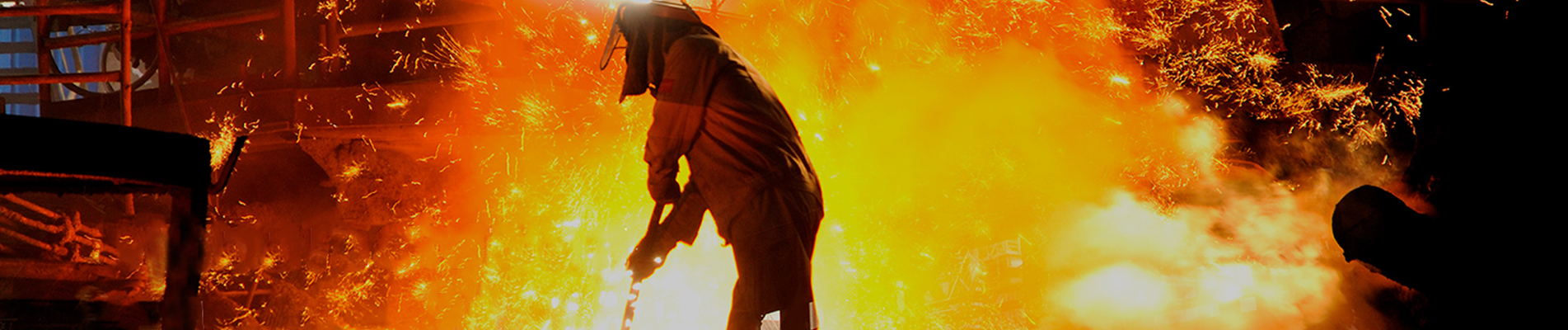
A manufacturing facility specializing in high-temperature processing equipment was seeking to upgrade its thermal insulation system. The existing insulation materials showed performance degradation after long-term exposure to elevated temperatures, leading to increased energy consumption and maintenance costs.
The client required an insulation solution that could provide stable thermal performance, long service life, and reliable supply to support continuous industrial operation.
Before selecting the material, the client identified several key challenges:
Continuous exposure to high operating temperatures
Need for consistent insulation thickness across large surface areas
Resistance to vibration and mechanical stress
Long-term performance stability with minimal maintenance
The project demanded a material that could meet both thermal and mechanical requirements without frequent replacement.
After evaluating different insulation materials, the project team selected e-glass needle mat due to its balanced performance characteristics.
Key reasons for selection included:
Excellent thermal stability under continuous high-temperature conditions
Uniform fiber structure ensuring consistent insulation performance
Mechanical strength suitable for industrial environments
Compatibility with existing installation and processing methods
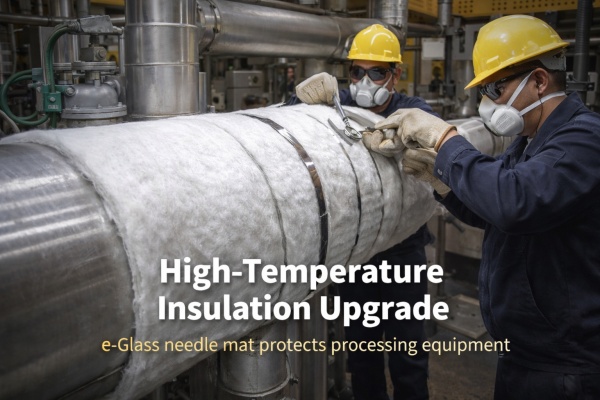
The needle mat was applied as a thermal insulation layer around high-temperature equipment and connecting components. Thanks to its flexible structure and controlled thickness, installation was completed efficiently without the need for complex modifications.
During installation, the material demonstrated:
Good flexibility for complex shapes
Stable structure without fiber separation
Minimal dust generation during handling
This helped reduce installation time and improve on-site safety.
Following installation, the client observed several measurable improvements:
Improved thermal insulation efficiency
Reduced heat loss during continuous operation
More stable surface temperatures
Lower maintenance frequency compared to previous materials
These results contributed to improved energy efficiency and operational reliability.
According to the project team, the insulation upgrade delivered consistent performance under demanding conditions. The stable structure and durability of the needle mat helped reduce downtime and supported long-term operation.
The client also highlighted the importance of stable supply and consistent quality for future expansion projects.
This project demonstrates how proper material selection can significantly improve industrial insulation performance. For applications involving high temperatures and continuous operation, materials must deliver both reliability and longevity.
The successful use of e-glass needle mat in this case highlights its suitability for demanding industrial insulation projects.
As industries continue to upgrade insulation systems, application-proven materials will play an increasingly important role in achieving long-term operational success.

 français
 Deutsch
 русский
 italiano
 español
 português
 Nederlands
 العربية
 日本語
日本語 한국의
한국의 Türkçe
 Polski
 Tiếng Việt
 slovenský
 Indonesia