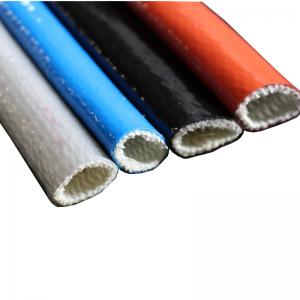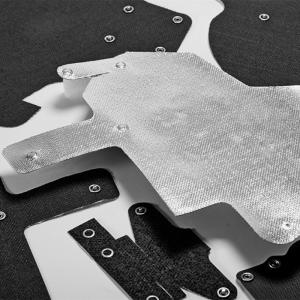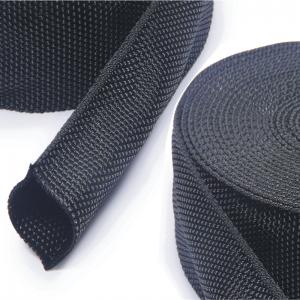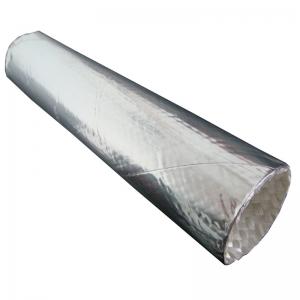
Fire sleeve working temperature is often presented as a simple number on a datasheet. In reality, it is not a single value—it is a range of thermal behaviors under different conditions.
Understanding fire sleeve working temperature is not about memorizing limits. It is about knowing what happens before, during, and after extreme heat or flame exposure, and how long the fire sleeve can continue to protect the system when failure becomes likely.
This page focuses entirely on thermal performance boundaries, not product descriptions or applications.
Many buyers assume working temperature means:
“The maximum temperature fire sleeve can survive.”
In engineering terms, this is incorrect.
Fire sleeve working temperature actually depends on:
Exposure duration
Type of heat (radiant vs flame)
Distance from heat source
Hose material underneath
Environmental airflow
A fire sleeve exposed to 260°C continuously behaves very differently from one exposed to direct flame at much higher temperatures for a short period.
This refers to long-term operating conditions, such as hoses routed near:
Engines
Exhaust pipes
Furnaces
In this scenario, the fire sleeve must:
Retain flexibility
Avoid hardening or cracking
Maintain insulation performance
For most silicone-coated fire sleeves, continuous working temperature is up to 260°C under normal industrial conditions.
This refers to emergency fire events, such as:
Hydraulic fluid ignition
Fuel line fires
Equipment fires
Here, the goal is not comfort or longevity. The goal is survival time.
During flame exposure, fire sleeve is designed to:
Resist ignition
Form a protective char
Delay heat transfer to the hose
In controlled tests, fire sleeve can withstand short-term flame exposure up to approximately 1090°C, depending on construction and test method.
Silicone outer layer absorbs heat
Surface temperature rises rapidly
No structural damage yet
Silicone begins to vulcanize
A charred outer layer forms
Heat penetration slows
Fiberglass inner layer remains stable
Hose temperature rises slowly
System integrity is temporarily preserved
This staged behavior is why fire sleeve is effective during fire incidents—it fails gradually, not instantly.
Unlike thermoplastics, fire sleeve materials are chosen specifically to avoid melting or dripping.
Fiberglass does not burn or melt under fire exposure
Silicone rubber chars instead of flowing
This prevents:
Dripping material feeding the fire
Sudden collapse of the sleeve
Immediate exposure of the hose surface
From a safety perspective, this behavior is more important than the absolute temperature number.
A critical but often ignored factor is time.
Two fire sleeves exposed to the same temperature may perform very differently if:
One is exposed for 10 seconds
The other for 5 minutes
Fire sleeve working temperature should always be interpreted together with:
Expected fire duration
Emergency shutdown response time
Fire sleeve is designed to buy time, not provide infinite protection.
Choosing based only on peak temperature
→ Ignores exposure duration and heat type
Ignoring radiant heat accumulation
→ Continuous radiant heat can degrade materials over time
Assuming “higher rating = unlimited safety”
→ Even fire sleeve has limits
Overlooking hose material compatibility
→ The hose may fail before the sleeve
Instead of asking “What is the maximum temperature?”, engineers ask:
How long must the hose survive in a fire?
What heat source is most likely?
What happens if the sleeve degrades?
Fire sleeve is then selected as part of a system-level safety strategy, not as a standalone solution.
Q1: Can fire sleeve handle constant open flame?
No. It is designed for short-term flame exposure, not continuous fire.
Q2: Does thicker fire sleeve mean higher temperature resistance?
Not always. Material quality and construction matter more.
Q3: Can fire sleeve be combined with other insulation?
Yes, but airflow and fit must be considered.
Q4: Will fire sleeve fail suddenly when overheated?
No, it degrades progressively, which is a key safety feature.
Q5: Is fire sleeve suitable for electric cables?
Yes, especially where fire risk exists.
Q6: How do I confirm real temperature performance?
Review test reports and understand the test conditions.
When correctly selected, fire sleeve provides critical protection during both continuous high-temperature operation and short-term fire exposure. Understanding how it behaves under heat allows engineers and buyers to use it as an effective safety tool rather than relying on misleading temperature numbers alone.

 français
 Deutsch
 русский
 italiano
 español
 português
 Nederlands
 العربية
 日本語
日本語 한국의
한국의 Türkçe
 Polski
 Tiếng Việt
 slovenský
 Indonesia