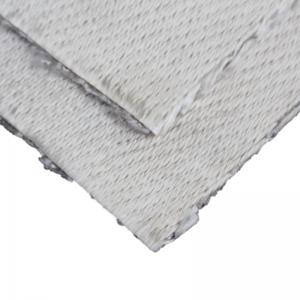
BSTFLEX Aluminum Coated High Silica Fabric combines a flexible high-silica base with an aluminum surface for fabricated heat shields, curtains and protective covers. Choosing the material is one part of the job. The installation must also establish what it protects, where it sits and how it stays in position.
Before choosing fabric thickness, identify the part at risk and its allowable operating temperature. A shield intended to protect a cable connector has a different acceptance target from a panel intended to reduce heat reaching a machine enclosure.
Mark the hot surface or furnace opening on the layout, then mark the component requiring protection. Record the available clearance, movement during operation and access needed for maintenance. Include nearby ventilation openings rather than treating them as unused space for the shield.
Also establish whether the component is heated mainly from outside or generates significant heat internally. Enclosing a component without checking its cooling requirements can solve the wrong problem. The design target should be a measured operating condition at that component, not simply a fabric that survives beside it.
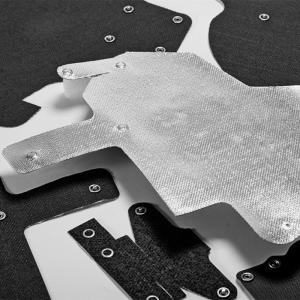
A freestanding or bracket-mounted panel is a useful arrangement to evaluate when there is room between a radiant source and the equipment. Position the reflective face toward the source, with its backing toward the protected side.
On the drawing, check whether the panel actually interrupts the exposed component’s view of the hot surface. Include side angles, openings around brackets and the positions reached by moving parts. A panel that covers the component in a front-view photograph may leave it exposed from another direction.
Specify how the panel will retain its shape. Inspect the minimum clearance at the center as well as at the attachment points; do not approve the installation using the edge spacing alone.
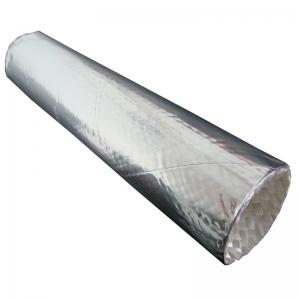
A reflective cover can be considered where the exposed component has an irregular shape or where a separate panel cannot be accommodated. In this arrangement, the aluminum face is on the outside, toward the external radiant source.
Include connectors, inspection points, bends and the closing seam in the pattern. State where the cover may touch the protected component and where clearance is required. Check access and ventilation before finalizing the shape.
This is not the same arrangement as tightly wrapping the heat-generating pipe itself. For a hot pipe or housing, assess contact temperature and the insulation construction separately. Do not transfer a reflective-cover specification to a direct-contact wrap without that review.
An insulation assembly may use different textiles on its hot side and outer surface. Place the aluminized layer where its own operating limits and reflective function can both be met, rather than automatically putting it at the hottest location.
Request a section drawing showing the facing, insulation, backing and attachment method. Identify any bonded interfaces. A reflective face buried against another solid layer is not operating as an exposed radiant barrier at that interface.
For layer-specific temperature questions, refer to the silica fabric temperature guide. The base textile’s rating should not be used as the service limit of every surface treatment or bond in the assembly.
The air space lets the exposed reflective surface interact with incoming radiation without direct contact at that face. It does not make the entire assembly immune to heat transfer. Hot air and conductive paths through supports remain separate concerns; an aluminum surface does not reflect convection.
Do not specify a standard gap solely because another installation used it. Select and validate the clearance for the actual source, panel size, airflow, component temperature limit and available space.
For a flexible panel, record the smallest clearance expected during operation, including sag, vibration and installation tolerances. State how the supports will maintain it. A larger nominal gap on a drawing is of little value if the fabric can move into contact with the hot equipment.
The word aluminized does not identify every layer in a textile. An aluminum foil facing and a metallized-film facing are different constructions, even when both have a silver appearance. A purchasing specification should identify the actual surface layer and any carrier or bonding layer rather than assuming they are interchangeable.
For aluminum coated silica fabric, request the base-cloth specification, finished weight, thickness, usable width and the arrangement of treated faces. Ask which dimensions include the complete finish and which refer only to the textile underneath.
Where a laminate is proposed, identify its approved temperature conditions and required bond performance. Where a surface is applied by another process, request the corresponding construction details. Do not assume that the reflective face is also a self-adhesive backing.
For a repeat order, reference the approved sample and material revision. Record any proposed change in the facing or bonding system before accepting a substitute.
Use the following design-review questions alongside the part drawing. They are checks to resolve for the project, not fixed dimensions or claims of completed testing.
| Detail | Question to resolve | What to put on the drawing or specification |
|---|---|---|
| Coverage | Can the protected component still face the hot source through an edge opening? | Panel outline, seams, openings and positions of moving components. |
| Support | Can the fabric sag or move into contact during operation? | Support locations and the minimum operating clearance. |
| Attachments | Are loads concentrated at a small number of holes or clamps? | Required edge reinforcement, fastening method and local support. |
| Heat paths | Does a mounting bracket connect hot equipment directly to the protected side? | Mounting arrangement and locations to check during the thermal trial. |
| Service access | Will maintenance disturb the panel or reverse its orientation? | Removal method, orientation marking and refitting checks. |
| Surface condition | Will the exposed face collect deposits or rub against adjacent parts? | Inspection access, permitted cleaning method and criteria for reviewing damage. |
Keep edge binding, stitching and fasteners within the evaluation. A flat fabric sample does not establish the performance of a finished shield with holes, folds and seams.
For a flexible component, trial the actual folds and overlaps before approving the production pattern. Avoid relying on an unused, flat sample when the supplied part will spend its service life bent around a bracket or repeatedly removed.
A practical validation plan should define the protected-side temperature limit before the trial. Select measurement points at the critical component and near relevant edges, seams or attachments. Record the source condition, distance, airflow and exposure duration so that comparisons remain meaningful.
Where safe and technically appropriate, compare the proposed shield with the existing arrangement under equivalent conditions. Include the relevant startup, steady-operation or shutdown periods rather than selecting only the moment that gives the most favorable result.
A thermal image of the aluminum face is not sufficient proof of shielding performance. Shiny metallic surfaces can give misleading apparent temperatures because an infrared camera detects reflected radiation as well as radiation emitted by the surface. Emissivity and reflected-temperature settings matter.
Use a measurement method suited to the surface and operating conditions. Properly installed contact sensors or a qualified infrared measurement procedure may be appropriate. Keep the acceptance decision tied to the temperature of the component being protected, together with the condition of the shield after the trial.
A reflection percentage is also not a guaranteed percentage reduction in component temperature. Those are different quantities. Ask for the measurement method and test configuration behind any performance figure, then determine whether that configuration represents the proposed installation.
A project may combine radiant heat with hot gases, sparks or intermittent contact. Identify these as additional exposures instead of assuming that a reflective surface addresses all of them.
For direct hot-surface contact, request approval of the complete construction at the expected interface temperature. For molten-metal exposure, flame impingement or a safety-critical fire barrier, require an assessment and evidence specific to that duty. A roll of reflective silica fabric should not be treated as a certified finished protective system solely because of its base material.
Likewise, do not select a silica fabric heat shield as a pressure-containing or gas-tight component without a separate qualified design. This material is offered as a protective textile, not as a pressure boundary.
Send the application sketch with the radiant source, protected component and proposed shield position clearly marked. Include the normal and peak conditions, exposure duration, available clearance and the allowable temperature at the protected part. State whether the requirement is for roll material or a fabricated component.
For roll goods, specify finished fabric weight, thickness, usable width, roll length and quantity. For a fabricated shield, add dimensions, seams, reinforcement, attachment details and the required removal method. Identify any backing, bonding or insulation layer separately.
BSTFLEX provides OEM and custom manufacturing support for high-temperature textiles. Use the intended construction for sample evaluation, then carry the approved requirements into the production specification.
Review Aluminum Coated High Silica Fabric for this reflective textile option, or compare surface treatments in the silica fabric material-selection overview.
Request a material recommendation or quotation from BSTFLEX with the layout, thermal conditions, dimensions and quantity. The objective is an installed shield that keeps the specified component within its operating limit—not simply a silver fabric with a high temperature number.

 français
 Deutsch
 русский
 italiano
 español
 português
 Nederlands
 العربية
 日本語
 한국의
 Türkçe
 Polski
 Tiếng Việt
 slovenský
 Indonesia