A woven nylon hose sleeve is a heavy-duty protective covering engineered to safeguard hydraulic hoses, pneumatic lines, industrial tubes, and cable assemblies from abrasion, external wear, and environmental damage. Unlike expandable braided sleeves, this product is produced by a dense woven process that creates a stable, non-expanding tubular structure with consistent thickness and uniform mechanical strength. With available wall thicknesses of one to two millimeters and flattened widths ranging from ten to five hundred millimeters, the woven nylon sleeve can accommodate a wide variety of hose sizes and industrial applications.
Hydraulic systems operate under extreme pressures and demanding conditions that expose hoses to friction, vibration, impact, and potential ruptures. As a protective barrier, a woven nylon hose sleeve significantly extends the service life of industrial hoses by reducing abrasion and mechanical stress. This article provides a complete overview of the structure, performance, applications, technical data, installation methods, and maintenance practices associated with woven nylon hose sleeves. It serves as a detailed resource for engineers, equipment manufacturers, procurement managers, and maintenance professionals.
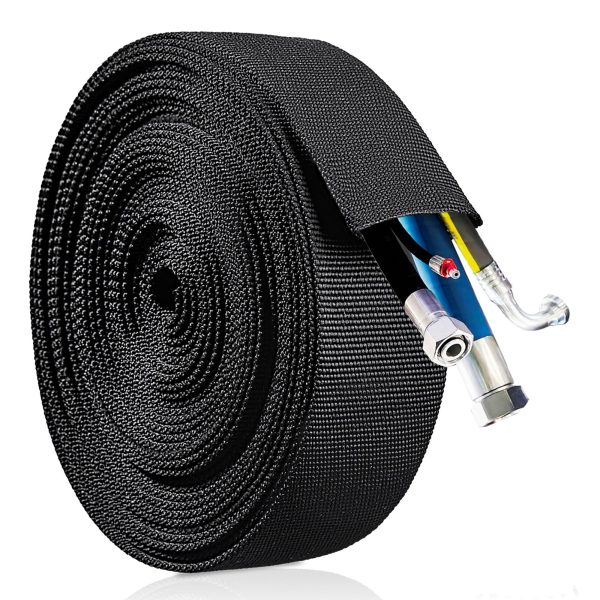
A woven nylon hose sleeve is a protective tubular textile manufactured using tightly interlaced high-strength nylon yarns. Because of its woven structure, the sleeve maintains a fixed diameter and does not expand during installation. This stability allows for highly consistent protection, making it ideal for heavy-duty hydraulic applications where hose diameters and operating conditions are predictable and require uniform abrasion resistance.
Unlike braided sleeves, which expand and contract due to their construction, woven nylon sleeves provide a smooth, dense, and uniform protective barrier. The absence of expansion also allows greater material density and mechanical strength, resulting in stronger resistance to punctures, wear, and external pressure.
Woven nylon sleeves are available in a broad range of widths, from ten to five hundred millimeters, making them suitable for single hoses, multiple hose bundles, or large industrial tubes. Their wall thickness typically ranges from one to two millimeters, providing a durable protective layer capable of withstanding harsh environments.
The dense woven nylon structure offers exceptional resistance to surface wear caused by bending, rubbing, dragging, and repetitive motion. This makes the woven sleeve particularly effective in machinery with continuous vibration or movement.
Because the sleeve is woven rather than braided, it does not expand. This provides a consistent internal dimension that ensures reliable protection and uniform pressure distribution along the hose.
Woven nylon is engineered for long service life even when exposed to sharp edges, rough surfaces, heavy loads, or continuous friction.
Nylon fibers are resistant to oils, hydraulic fluids, fuels, solvents, and many other industrial chemicals, ensuring compatibility with harsh working environments.
With a flattened width range of ten to five hundred millimeters and customizable thicknesses, the sleeve can be tailored to different hoses, cable bundles, and equipment types.
Many woven nylon sleeves provide containment in the event of hose rupture, helping reduce the risk of hydraulic fluid spray and improving worker safety.
The sleeve maintains performance under sunlight, moisture, and outdoor exposure, making it suitable for mobile equipment and outdoor machinery.
Excavators, loaders, cranes, and drilling equipment rely on woven nylon hose sleeves to protect hydraulic lines that are exposed to continuous abrasion and impact.
In mining environments, hoses frequently rub against rocks, metal structures, and abrasive surfaces. Woven sleeves help prevent premature hose failure.
Harvesters, tractors, sprayers, and logging machinery depend on durable hose protection to withstand debris, branches, dust, and environmental exposure.
Robotic machinery, conveyors, presses, and automated systems use the sleeve to minimize wear caused by repetitive motion and vibration.
Nylon’s resistance to saltwater and humidity makes it suitable for marine hydraulics, winches, hoists, and offshore industrial equipment.
Woven nylon sleeves protect fuel lines, brake hoses, and cable assemblies in commercial vehicles, heavy-duty trucks, and industrial transport equipment.
| Property | Value |
|---|---|
| Material | High-tenacity woven nylon |
| Construction | Dense woven structure, non-expandable |
| Flattened Width Range | 10 to 500 millimeters |
| Wall Thickness | 1 to 2 millimeters |
| Temperature Range | Minus 40 to 120 degrees Celsius |
| Abrasion Resistance | Very high |
| UV Resistance | Good |
| Chemical Resistance | Resistant to oils, hydraulic fluids, fuels, most solvents |
| Containment Capability | Can help control hydraulic spray depending on grade |
| Color Options | Black (standard), custom colors available |
| Application Fields | Hydraulic hose protection, cable bundling, abrasion shielding |
Woven nylon hose sleeves differ significantly from braided sleeves in structure and performance.
Unlike braided sleeves, woven sleeves do not expand. This allows for better stability, predictable sizing, and higher material density.
The dense, flat woven structure provides superior resistance to surface wear compared to braided designs.
Braided sleeves are limited in expansion and width, but woven sleeves can be produced up to five hundred millimeters wide.
Because the sleeve does not stretch, it maintains a consistent dimension that improves fit and protection.
abrasion resistant nylon hose cover, woven hydraulic hose protection sleeve, heavy duty nylon protective tubing, industrial hose abrasion guard, non expandable nylon hose sleeve, hydraulic safety containment wrap, nylon hose protector for machinery
Choose a sleeve with a flattened width that appropriately accommodates the hose or bundle size.
For high-abrasion environments, a two-millimeter sleeve offers added durability. For lighter applications, a one-millimeter sleeve is sufficient.
For outdoor use, confirm UV resistance and chemical compatibility.
In industries such as mining or forestry, select sleeves with burst-containment capability.
Measure hose length and component size accurately. A clean, straight cut ensures easier installation.
Slip the sleeve over the hose manually. Because the sleeve does not expand, proper sizing is important. For multiple hose bundles, choose wider sleeves that allow easy arrangement.
Fasten both ends using clamps, straps, or heat-shrink bands to prevent sliding during operation.
Inspect regularly for signs of abrasion or tearing. Replace promptly when wear is noticeable. Clean with mild detergents to remove oil residue or contaminants. With proper maintenance, woven nylon hose sleeves offer an extended operational lifespan and reliable performance.
A woven sleeve does not expand, has a more stable structure, and provides greater abrasion resistance. Braided sleeves expand, while woven sleeves maintain a fixed size.
Standard production allows flattened widths from ten to five hundred millimeters, making the sleeve suitable for small hoses as well as large industrial assemblies.
Woven nylon sleeves can be produced in one-millimeter or two-millimeter thicknesses depending on application needs.
Many woven nylon sleeves provide spray containment, but performance depends on product thickness and construction.
Yes. Nylon offers strong resistance to UV light, moisture, and environmental exposure.
Construction, mining, agriculture, marine, industrial automation, heavy machinery, and transportation all rely on woven nylon sleeves.
No. The woven structure remains flexible and does not interfere with hose movement.

 français
 Deutsch
 русский
 italiano
 español
 português
 Nederlands
 العربية
 日本語
日本語 한국의
한국의 Türkçe
 Polski
 Tiếng Việt
 slovenský
 Indonesia