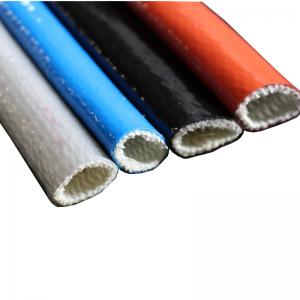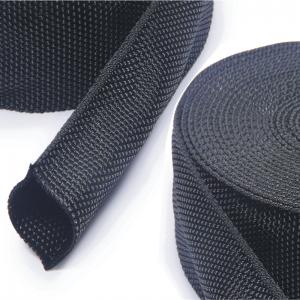
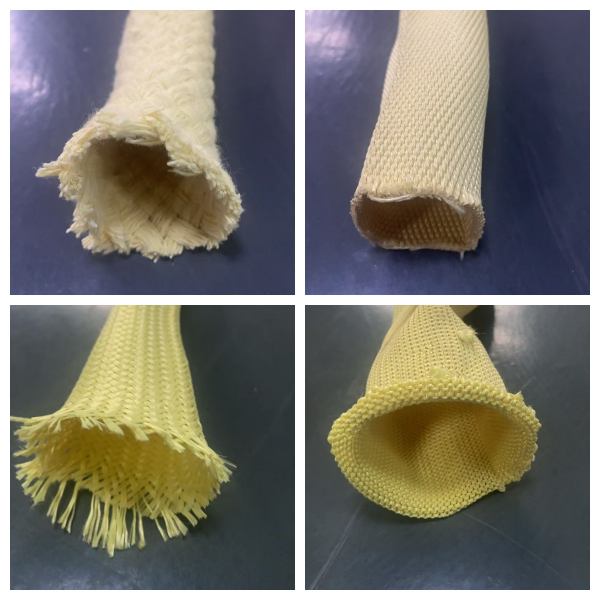
A braided aramid sleeve is a high-strength protective sleeving manufactured from aramid fibers and constructed in a dense braided structure. It is designed to protect hoses, cables, and wire harnesses from abrasion, cutting, and mechanical wear, particularly in applications involving movement, vibration, or contact with sharp surfaces.
Unlike thermal or fire-resistant sleeves, a braided aramid sleeve is primarily selected when mechanical damage is the dominant failure risk.
In many industrial systems, hoses and cables fail not because of internal pressure or temperature limits, but due to external mechanical stress.
Common failure causes include:
Continuous rubbing against metal frames or brackets
Repeated bending and vibration during operation
Contact with sharp edges, debris, or abrasive dust
Long service intervals with limited maintenance access
A braided aramid sleeve acts as a sacrificial protective layer, absorbing abrasion and impact before damage reaches the hose or cable itself.
Aramid fibers are widely recognized for their exceptional strength-to-weight ratio and resistance to mechanical damage.
When used in protective sleeving, aramid fibers provide:
Significantly higher abrasion resistance than PET or nylon
Strong resistance to cutting and tearing
Low elongation under mechanical stress
Stable performance under continuous movement
These properties make aramid an ideal material for environments where conventional textile sleeves wear out quickly.
The braided structure plays a critical role in sleeve performance.
Key benefits of braided construction include:
Uniform surface coverage around hoses and cables
Flexibility that allows bending and movement
Ability to expand slightly during installation
Consistent protection even under vibration
This design allows the sleeve to protect dynamic systems without restricting motion or increasing stress on the protected component.
A braided aramid sleeve is typically used when:
Abrasion is the primary cause of hose or cable damage
Components are in constant motion or vibration
Routing passes through tight spaces or near metal edges
Downtime or emergency repairs are costly
It is especially effective in abrasion-dominant environments, rather than heat- or fire-dominant ones.
Understanding limitations is essential for proper selection.
A braided aramid sleeve is not intended for:
Direct flame exposure
Radiant heat insulation
Fire containment or thermal shielding
In applications where heat or fire risk is dominant, fire-resistant or thermal protection sleeves should be considered instead.
Braided aramid sleeves are commonly used in:
Mining equipment – excavators, loaders, drilling rigs
Underground mining – hydraulic and cable protection
Robotics and automation – moving cable carriers and joints
Industrial machinery – vibrating or sliding hose assemblies
Construction equipment – mobile hydraulic systems
Automotive and motorsport – high-vibration environments
Any application involving mechanical contact and movement can benefit from aramid-based protection.
Compared to PET or nylon sleeves, braided aramid sleeves typically offer:
Much higher abrasion resistance
Longer service life under mechanical stress
Better resistance to cutting and tearing
Standard textile sleeves may be suitable for light-duty protection, but they often fail prematurely in aggressive mechanical environments.
Braided aramid sleeves are designed for easy integration:
Slide-over installation
Can be cut to length on-site
No adhesives or curing required
Compatible with clamps, ties, or terminations
They are suitable for both OEM manufacturing and retrofit applications.
Understanding what a braided aramid sleeve is helps ensure proper product selection. If your application involves abrasion, vibration, or mechanical wear, a braided aramid sleeve is often the most effective and economical solution.

 français
 Deutsch
 русский
 italiano
 español
 português
 Nederlands
 العربية
 日本語
日本語 한국의
한국의 Türkçe
 Polski
 Tiếng Việt
 slovenský
 Indonesia