There is no single correct thickness for every removable insulation blanket. Two covers installed on equipment at the same temperature may need different insulation thicknesses because the equipment diameter, ambient conditions, available clearance, core material and required surface performance are different.
A useful thickness decision starts with the job the blanket must do. Is the priority to reduce heat loss, lower the exposed surface temperature, protect a nearby component, maintain process temperature or fit insulation into a restricted space? The answer changes the construction.
BSTFLEX manufactures removable insulation blankets for valves, pipes, exhaust parts, filters, drums and industrial equipment. Blanket thickness can be adjusted to suit the equipment and service conditions rather than forcing every application into one standard build.
The operating temperature is important, but it cannot determine blanket thickness by itself. A thickness recommendation should consider at least:
A project specification may state a nominal core thickness, a maximum heat loss, a required outer-surface temperature or a combination of these requirements. When performance is specified, the thickness should be checked by a suitable heat-transfer calculation rather than chosen from a temperature-only chart.
Buyers often use the word thickness without identifying what is being measured. A removable cover has several layers, and three different values may be discussed during a project.
| Thickness term | Meaning | Why it matters |
|---|---|---|
| Nominal core thickness | The specified thickness of the insulation mat before final assembly and installation | Used for material selection and thermal calculations |
| Assembled blanket thickness | The approximate thickness after the shell, liner, seams and internal attachment are added | Affects the pattern, panel edges and handling |
| Installed thickness | The thickness after the blanket is fitted, closed and locally compressed around the equipment | Determines finished outside dimensions and real clearance |
The installed blanket will not remain perfectly uniform around every seam, flange edge or closure. When clearance is tight, the design should consider the thickest local area rather than relying only on the nominal core value.
When the purpose is energy conservation or process-temperature stability, the important value is heat flow from the insulated equipment under the expected operating and ambient conditions. Increasing core thickness generally reduces heat transfer, but each additional layer produces a smaller incremental improvement. Material cost, blanket size, weight and installation space also increase.
The economic thickness is therefore not automatically the thickest construction that can be sewn. It is the construction that provides the required thermal result at a practical installed size and project cost.
When personnel protection or nearby components are the main concern, the project may specify a maximum blanket surface temperature. This should be evaluated using the actual equipment temperature, ambient temperature, air movement, blanket orientation and surface properties.
A surface-temperature result measured in still indoor air should not be assumed for outdoor service with wind, rain or direct sunlight. The test or calculation conditions need to be stated.
Some valves, exhaust components and process assemblies are installed close to guards, walls, floors or adjacent pipework. A thick blanket may provide good insulation on paper but be impossible to fit, close or remove.
Low-clearance projects may require a thinner core with better thermal efficiency, a segmented blanket, reduced thickness only at the restriction, or a change in closure location. Any local reduction must be reviewed because it can create a hotter area on the finished cover.
Injection barrels, heated filters, drums and other process equipment may need insulation to reduce cycling or maintain product temperature. In these applications, heater power, operating cycle, warm-up time and access requirements can matter as much as the maximum surface temperature.
Two insulation materials with the same nominal thickness do not necessarily provide the same thermal performance. The relevant value is the material thermal conductivity across the expected temperature range, together with density, compression behaviour and long-term stability.
Fiberglass needle mat is widely used in flexible industrial covers because it can be cut, layered and sewn into irregular patterns. It is suitable for many general hot-service applications when the selected grade matches the operating temperature. The final thickness should account for compression at quilting points, seams and tight bends.
Silica needle mat is selected where a higher-temperature core is required while retaining a flexible, needled construction. Material composition, density and available thickness should be confirmed rather than assuming that every silica mat has the same performance.
Ceramic-fiber insulation may be considered for more demanding hot-service conditions. The blanket design still needs a suitable hot-face liner, outer shell, sewing thread and closure arrangement. A high-temperature core does not make the entire assembly suitable for the same temperature automatically.
A high-efficiency flexible insulation may help where space or weight is limited, but the comparison should be made using project thermal data, handling requirements and total installed cost. A thin material is not automatically the best choice if it is easily damaged, difficult to sew or unsuitable for repeated removal.
BSTFLEX supplies selected high-temperature insulation cores in multiple material types and thicknesses. Availability depends on the core grade and project specification. Buyers who fabricate their own covers can also review the removable insulation blanket materials guide.
A maximum material-use temperature describes thermal capability under stated conditions. It does not tell the buyer how much heat will pass through the blanket or what the outer surface temperature will be.
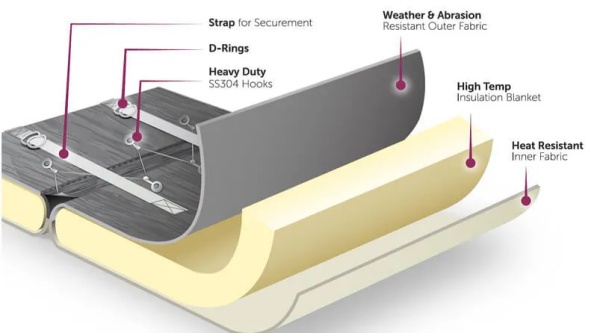
Insulation performance depends on the complete assembly. A material may tolerate the hot face but still need more thickness to meet a heat-loss target. Conversely, a thicker core cannot compensate for an outer fabric, thread or fastener that is unsuitable for the exposure.
The continuous service temperature and the short-duration peak should be supplied separately. Direct flame, exhaust leaks, molten splash and radiant heat from a neighbouring source are different conditions and should not be treated as ordinary surface contact.
Heat transfer from a small valve body is not identical to heat transfer from a large flat vessel at the same temperature. Curvature, surface area, orientation and local airflow affect the result.
Blanket thickness also changes the finished outside size. On a small pipe, adding insulation around the full circumference can produce a large percentage increase in outside diameter. This may affect clamps, guards, walkways and the distance to adjacent lines.
For a large filter or drum, the same nominal thickness may create a heavy panel that is difficult to remove as one piece. Dividing the cover into labelled sections can improve handling without changing the selected core thickness.
Thermal calculations often start with a uniform insulation layer, but a sewn cover includes overlaps, seams, cutouts, quilting points and fasteners. These details keep the blanket together and make it removable, yet they can also affect local thickness.
These effects are especially important on valves, flanges and equipment with many penetrations. The removable valve insulation jacket design should provide access to the stem, handle or actuator while keeping the insulation boundary as continuous as practical.
Measure the minimum distance from the bare equipment to every nearby obstruction. Include walls, floors, guards, cable trays, support steel, neighbouring pipes and moving parts.
The required space is more than the nominal core thickness. Allowance may be needed for:
A blanket that fits into the static gap but cannot be opened or removed is not a practical removable design. Use the measurement procedure in how to measure for a custom removable insulation blanket before the final core thickness is approved.
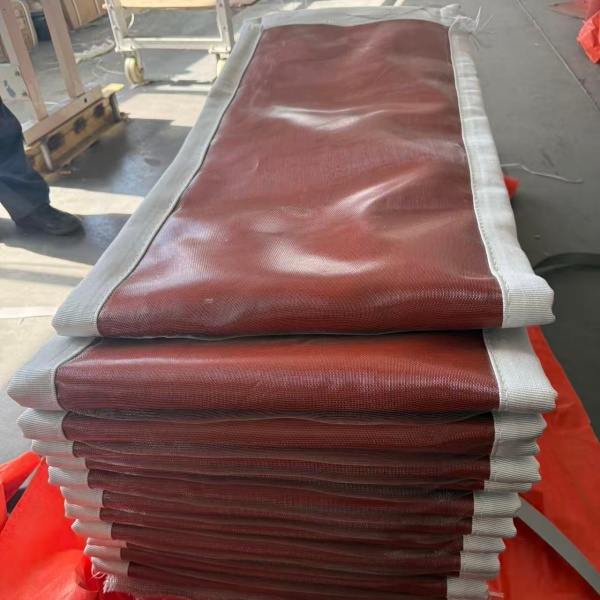
Flexible insulation cores contain air spaces that contribute to thermal resistance. Excessive compression reduces thickness and can change performance. Compression may occur at seams, under straps, around small radii or when a blanket has been patterned too tightly.
The purpose of the closure is to hold the blanket securely, not to crush it against the equipment. If a cover repeatedly needs excessive force to close, check the equipment dimensions, pattern, overlap and core thickness rather than simply tightening the hardware.
For repeat production, the approved sample should define how blanket thickness is checked. The inspection point, measuring method and acceptable tolerance should be consistent because a soft blanket can give different readings under different pressure.
A thick insulation section may be built from more than one layer. Multiple layers can make cutting and assembly easier and may reduce the chance that joints align through the full thickness. They can also allow different materials to be combined where the project requires it.
Layering must be controlled. Unsecured layers can shift, bunch or separate during handling. The design should specify layer orientation, joint location, internal attachment and the way the core is retained inside the shell.
Using more layers does not automatically improve the result if the finished assembly is heavily compressed or poorly fitted.
| Project condition | Likely design direction | Information needed |
|---|---|---|
| Heat-loss reduction is the main objective | Calculate core type and thickness against the required heat flow | Surface temperature, ambient conditions, equipment dimensions and heat-loss target |
| Outer-surface temperature is limited | Select the assembly against the stated touch or surface-temperature target | Target temperature, ambient temperature, wind and blanket orientation |
| Clearance is restricted | Review thinner cores, local profiling or segmented construction | Minimum gaps, photographs and removal direction |
| Blanket is removed frequently | Balance thermal thickness with handling, panel size and core retention | Maintenance interval, installer access and acceptable panel weight |
| Equipment has strong vibration | Control core movement, quilting and closure security | Vibration source, mounting position and service cycle |
| Irregular equipment has many penetrations | Use shaped sections and controlled overlaps rather than one bulky cover | Detailed dimensions, photographs and access points |
Where a project specification calls up an industrial insulation standard or a prescribed calculation method, those requirements should control the selection. Do not replace a required engineering calculation with a general online thickness chart.
To receive a useful recommendation and quotation, provide:
For a new custom project, the custom removable insulation blanket manufacturer page explains the drawing, material and production routes available from BSTFLEX.
The same operating temperature can require different thicknesses for different equipment sizes, ambient conditions and performance targets.
A core may survive the temperature but still be too thin to meet the required thermal result.
Core thickness increases the blanket outside envelope and may interfere with guards, walkways, supports or adjacent equipment.
A tight closure is not a substitute for a correct pattern. Excessive compression can reduce installed thickness and create uneven performance.
Local clearance and geometry may require separate blanket sections or controlled thickness changes. These changes should be documented rather than made informally during installation.
The shell, liner, seams and hardware also affect the finished size and service capability. The complete construction needs to be reviewed.
There is no universal standard thickness for every application. Projects should select thickness according to the core material, equipment temperature, ambient conditions, performance target, geometry and available clearance.
Additional thickness usually reduces heat transfer when the material and installation remain suitable, but the improvement is not linear. More thickness also increases size, weight, cost and installation clearance.
Local profiling may be possible, but the reduced area may become hotter or lose more heat. The design should be reviewed rather than trimming or compressing the blanket during installation.
The project should define whether it is checking nominal core thickness, assembled thickness or installed thickness. A flexible cover can compress under the measuring tool, so the method and pressure should be consistent.
Yes, when the combination serves a defined thermal or construction purpose. Layer order, material compatibility, retention and total thickness should be specified.
Clearance must accommodate the complete blanket, seams, overlap and fastening hardware, plus the space needed to install and remove it. Measure the narrowest point and show nearby obstacles in photographs.
Yes. Core type and nominal thickness can be selected for the project, subject to material availability and fabrication requirements. Provide the thermal target and available space with the enquiry.
No, unless finished blanket dimensions are specifically requested. Provide actual equipment dimensions and identify any existing insulation. Pattern, seam and overlap allowances are handled during blanket design.
Send the equipment drawing, dimensions, operating temperature, ambient conditions, thermal target, minimum clearance and required quantity to sales@pkfiresleeve.com. BSTFLEX can review the application and quote a custom removable insulation blanket construction based on the information supplied.

 français
 Deutsch
 русский
 italiano
 español
 português
 Nederlands
 العربية
 日本語
日本語 한국의
한국의 Türkçe
 Polski
 Tiếng Việt
 slovenský
 Indonesia