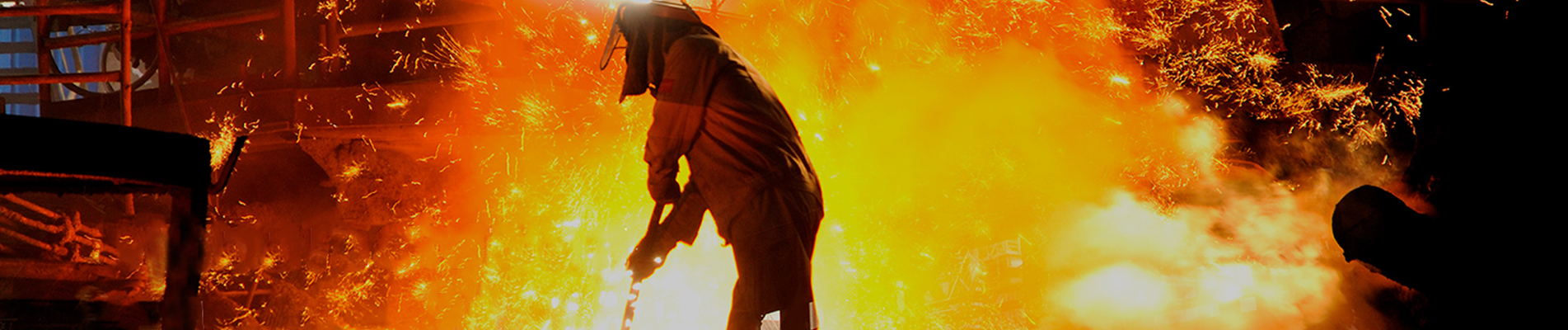
On an existing hose assembly, both end fittings may already be connected, the route may pass behind equipment, and access may be limited to a short exposed section. In that situation, the first fire sleeve question is not the nominal diameter. It is whether a tubular sleeve has a practical installation path.
A removable fire sleeve opens lengthwise so it can be wrapped around the hose instead of being fed over an end fitting. Snap and hook-and-loop closures offer two ways to close that opening. A tubular fire sleeve remains an option when end access is available or the protection can be installed during a planned hose replacement.
Choose the format around the installation and maintenance task, then verify its thermal suitability. The BSTFLEX fire sleeve range includes snap-wrap, hook-and-loop and tubular constructions for evaluating these different requirements.
| Decision point | Snap-wrap fire sleeve | Hook-and-loop fire sleeve | Tubular fire sleeve |
|---|---|---|---|
| Installation route | Wraps around the protected section and closes at individual snap positions. | Wraps around the protected section and closes along a mating fastening strip. | Slides along the assembly from an accessible end. |
| Hose disconnection | Can avoid disconnecting fittings when there is enough access to wrap and close the sleeve. | Can avoid disconnecting fittings when the closure can be reached and fully engaged. | Requires a clear end-entry path; evaluate during assembly or an approved disconnection. |
| Later inspection | Open the required snaps to expose the protected section. | Separate the fastening strips to expose the protected section. | Access beneath it requires sliding back or removing the sleeve where the assembly permits. |
| Critical fit check | Snap alignment and retained material overlap between fasteners. | Specified overlap and full engagement of the fastening surfaces. | Usable inside diameter, fitting passage and coverage along the route. |
| Useful starting point | A retrofit requiring a re-openable mechanical closure with accessible fastening positions. | A serviceable cover where a lengthwise fastening strip suits the access and maintenance routine. | A defined assembly process where regular opening along the sleeve is unnecessary. |
| Thermal acceptance | Evaluate the body, seam, snaps and installed overlap together. | Evaluate the body, seam, fastening material and installed overlap together. | Evaluate the body, fit and specified end treatment. |
This comparison identifies installation differences, not a universal ranking of heat resistance. Metal snaps do not automatically make a sleeve suitable for a hotter application, and a closed tube does not by itself establish a flame-exposure rating.
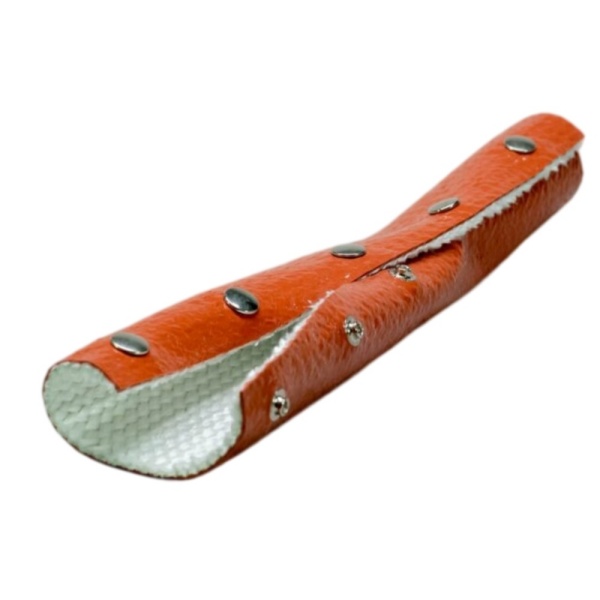
The BSTFLEX snap wrap firesleeve combines silicone-coated fiberglass protection with a metal snap closure. The sleeve can be opened along its length, positioned around the assembly and closed without feeding the entire cover over a fitting.
Evaluate this construction when the installation allows each fastening position to be reached and checked. In a cramped hose bank, confirm that a technician can press the mating parts together without twisting the hose or forcing the sleeve against a bracket.
The important inspection area is also between the snaps. A sleeve can have every button fastened yet still lose the intended overlap at a bend. Approve the closed fit on the actual route, including the outer side of bends and the equipment's permitted movement.
Specify fastener spacing, overlap and end positions in the agreed construction. Avoid assuming that one snap pattern will suit every diameter, bend or protected length.
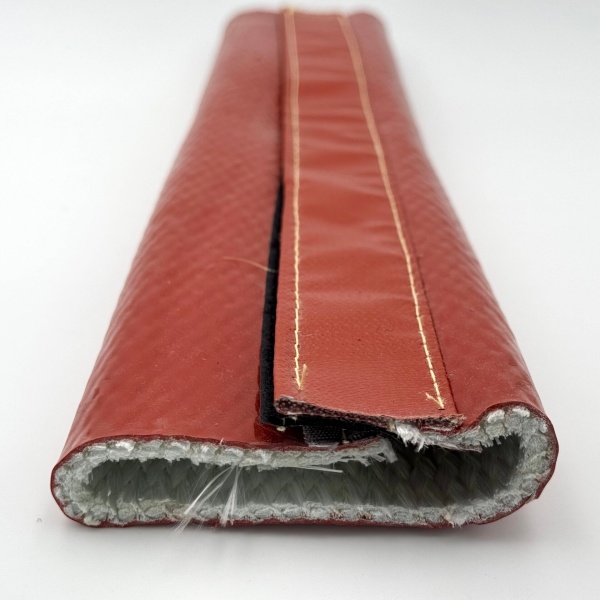
A BSTFLEX hook-and-loop fire sleeve provides another openable format for existing hoses and cables. The VFRS product uses silicone-coated braided fiberglass with a flame-retardant nylon hook-and-loop closure sewn internally using glass fiber thread.
This format is worth evaluating when the maintenance routine involves opening a lengthwise seam and pressing it closed again. Check that the installation provides enough access to engage the required fastening area, not merely the visible front edge.
Do not select the closure by applying the silicone-coated body's temperature figure to every component. Request the operating limits and test basis for the finished configuration, including the fastening material, stitching and protective overlap.
Where dust, fibers, oil or process debris are expected, include those conditions in the closure evaluation and inspection plan. Do not assume a contaminated fastening surface will retain its original engagement. An ordinary adhesive-backed fastening strip is not an approved replacement for the specified sewn closure.
A removable cover is not necessary for every retrofit. When a hose is already scheduled for replacement, a tubular sleeve can be considered within the approved assembly sequence. It can also be practical where an accessible end and the fitting geometry allow installation without excessive force.
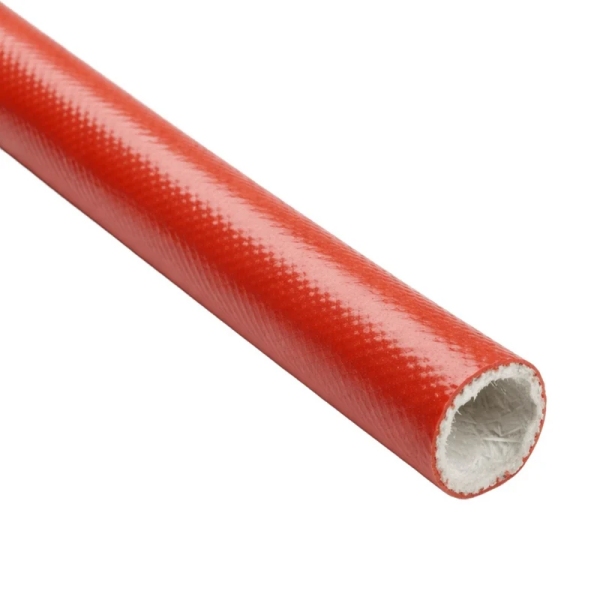
The BSTFLEX EFRS tubular fire sleeve uses silicone-coated braided fiberglass. It has no user-openable longitudinal closure to engage after installation, although fitting clearance, bends and end treatment still need to be checked.
Choose this route when the installation process is defined and regular opening along the protected length is not required. Do not cut an ordinary tubular sleeve lengthwise and treat it as an equivalent removable product. That changes the coverage and introduces an unqualified seam.
Specify the outside dimensions of the protected section and the usable closed fit of the removable sleeve. Flat material width alone does not establish the finished diameter or the remaining overlap. Hook-and-loop fastening should not be treated as permission to close the sleeve at any convenient width.
For a tube, check the installation path as well as the final fit. The fire sleeve size chart and fitting-clearance guide explains those dimensional checks separately.
Identify the heat source and any likely flame, spark or molten-splash direction on the installation drawing. Have the seam orientation and overlap reviewed for that exposure. There is no single clock position that is correct for every machine, and an accessible seam is not automatically a suitably protected seam.
Check the complete route, not only a straight sample on a bench. Mark clamps, supports and areas where the hose moves. Confirm that the closure remains engaged, the cover does not snag and no edge or fastener is forced against a neighboring component. Changes to hose supports must follow the equipment's approved arrangement.
Plan how the sleeve will be opened after installation and where the technician can see the hose beneath it. For longer runs, discuss separate serviceable sections rather than assuming one continuous cover is best. Any joints between sections need an agreed coverage detail; convenience alone does not define an acceptable overlap.
Consider a hypothetical hydraulic hose routed beside hot equipment. Both ends are connected, the fittings are larger than the hose body, and the maintenance team needs periodic access to inspect the cover beneath the thermal protection.
A removable fire sleeve is a sensible starting point because it addresses both end access and later inspection. Compare snap-wrap and hook-and-loop samples on that route. For the snap version, check access to every fastening position and coverage between them. For the hook-and-loop version, check full engagement, the actual fastener specification and its suitability for the contamination and exposure conditions.
Now change the scenario: the hose will be replaced during a scheduled shutdown and the approved design does not require frequent opening along its length. A tubular sleeve becomes a practical alternative because the assembly process can provide end access. The decision changes with the maintenance task, not because one closure is universally superior.
Provide the normal heat exposure, distance from the source, expected duration and any abnormal flame or splash requirement. Ask for product information applicable to the proposed sleeve and closure configuration rather than relying on a generic material description.
Where a test report or approval is required, check whether it covers the same body material, seam, closure and installation arrangement. Evidence for an uncut tubular sleeve should not automatically be applied to a modified wrap-around construction.
Include the protected hose's operating limits in the review. A removable sleeve does not increase its pressure rating or authorize operation beyond its temperature limit. It should not be specified as a leak repair, hose-burst restraint or high-pressure fluid-injection guard without separate, explicit qualification for that purpose.
Installing a fire sleeve without disconnecting the hose describes the fitting arrangement, not permission to work on operating equipment. Follow the site's safe-service procedure: shut down and isolate the equipment, control stored hydraulic and other energy, and verify the safe condition before work. Allow hot components to cool to a safe handling condition.
Have qualified personnel assess a leaking, heat-damaged or mechanically damaged hose before adding a cover. Do not conceal an existing defect with thermal sleeving or reach around a pressurized line to close a fastener.
A retrofit sleeve may remove disconnection and reconnection steps from the job. It does not remove the need for a safe maintenance window.
Reopening a sleeve provides access for inspection; it does not prove that the sleeve remains serviceable after every exposure. Establish acceptance and replacement criteria for the coating, fiberglass body, stitching, closure and end treatment.
Before refitting, inspect for tears, damaged stitching, distorted snaps, inadequate fastening engagement and contamination. After a significant flame or molten-splash event, obtain a competent assessment or replace the affected protection according to the approved procedure. Do not use successful reclosure as the only acceptance check.
Retain the sleeve identification and installation detail with the maintenance record. A replacement of the same color and approximate diameter may not have the same construction.
| Information | What the supplier needs |
|---|---|
| Existing assembly | Hose or bundle outside dimensions, route photographs and locations of fittings, clamps and supports. |
| Installation constraint | Whether either end is accessible, whether disconnection is permitted and the space available to operate the closure. |
| Protected section | Required coverage length, bends, moving areas and any proposed section joints. |
| Closure requirements | Snap or hook-and-loop preference, specified materials, overlap, fastening arrangement and expected inspection frequency. |
| Exposure | Heat source, normal and short-duration conditions, splash direction, fluids and process contamination. |
| Acceptance requirements | Relevant test documents, sample-fit checks, movement evaluation and any approved equipment drawing. |
| Supply format | Quantity, finished lengths or roll supply, identification, color and packaging requirements. |
For repeated OEM or maintenance orders, approve a finished sample with its closure and overlap, not just a fabric swatch. Compare the installed result and maintenance access alongside the price per meter.
The descriptions can refer to a lengthwise-opening cover, but they do not identify the fastening system or tested construction. Specify the closure, closed fit, overlap and material rather than ordering by the word split alone.
No universal comparison follows from the fastener name. The body, stitching, seam arrangement, exposure and finished-product evidence determine suitability. Metal hardware is not, by itself, proof of a higher-rated protective assembly.
A bundle cover can be evaluated, but first confirm that grouping the lines is permitted. Provide the finished bundle dimensions and review relative movement, heat buildup, inspection access and the coverage required for each line.
Not automatically. Provide the branch or connector geometry for review. A tailored cover or separate sections may be required; pulling a standard sleeve across a breakout can leave exposed areas or prevent correct closure.
For an existing installation, send BSTFLEX photographs of the hose route, the protected length, outside dimensions and heat-source location. State whether the hose must remain connected and how often the sleeve needs to open for inspection.
BSTFLEX can evaluate snap-wrap, hook-and-loop and tubular options against that installation, together with cut-length, identification and packaging requirements. Request product data, a sample or an OEM quotation with the assembly details so the proposed sleeve can be checked in its working position.

 français
 Deutsch
 русский
 italiano
 español
 português
 Nederlands
 العربية
 日本語
日本語 한국의
한국의 Türkçe
 Polski
 Tiếng Việt
 slovenský
 Indonesia