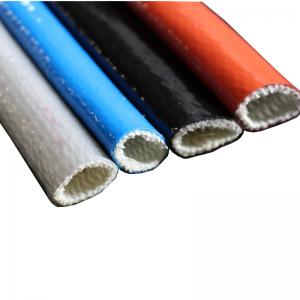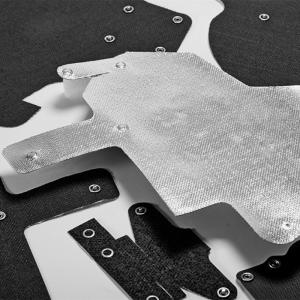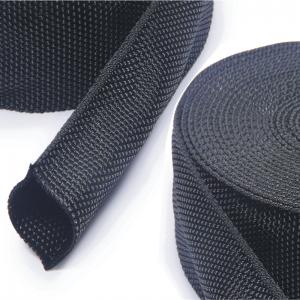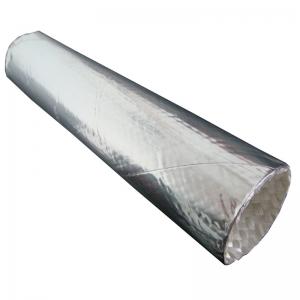
Braided and knitted fire sleeves can have the same silicone-coated exterior while using different fiberglass structures underneath. A braided fire sleeve uses interlaced yarns; a knitted fire sleeve uses interconnected loops. The difference matters during installation, bending and handling, but it does not establish which finished sleeve provides better thermal protection.
For a repeat-production hose assembly with a defined route, a braided construction is a practical starting point. When conformity around bends or changing assembly shapes is the main concern, evaluate a knitted alternative. Make the final choice from the finished sleeve specification and an installation sample, not the construction name alone.
The BSTFLEX fire sleeve range includes both constructions for hose, cable, wire and fluid-line protection. This guide explains what to compare before approving either type for production.
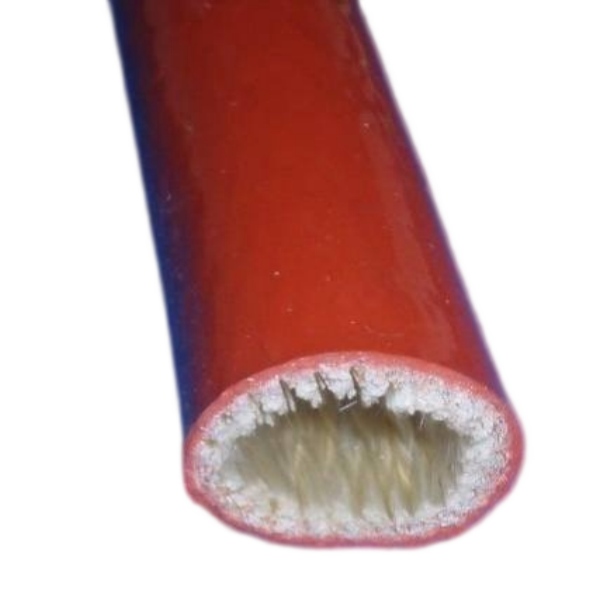
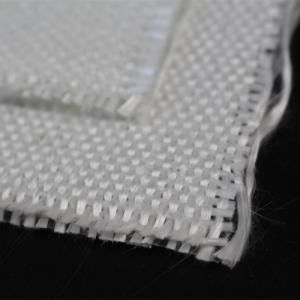
In a braided fire sleeve, fiberglass yarns cross around the tube in an interlaced pattern. Braid geometry and yarn packing determine the textile structure before the silicone coating is applied.
A closely constructed braid can provide a compact tubular body for handling and assembly. Braided does not mean rigid: expandable braided structures also exist. The permitted expansion of a finished silicone-coated sleeve must be established for that product rather than inferred from an uncoated braid.
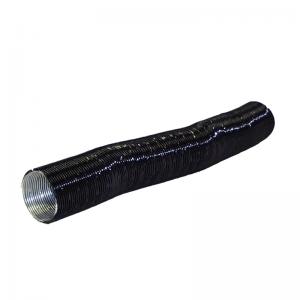
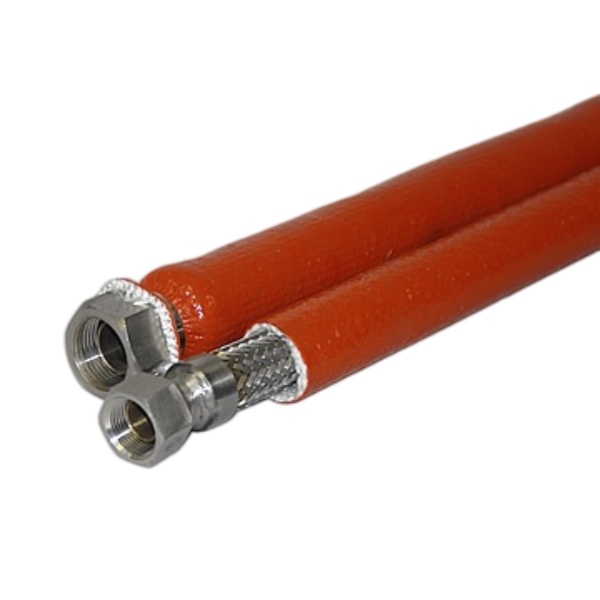
The BSTFLEX EFRS braided silicone fiberglass fire sleeve combines a braided fiberglass substrate with silicone rubber and is offered for protecting hoses, wires, cables and lines.
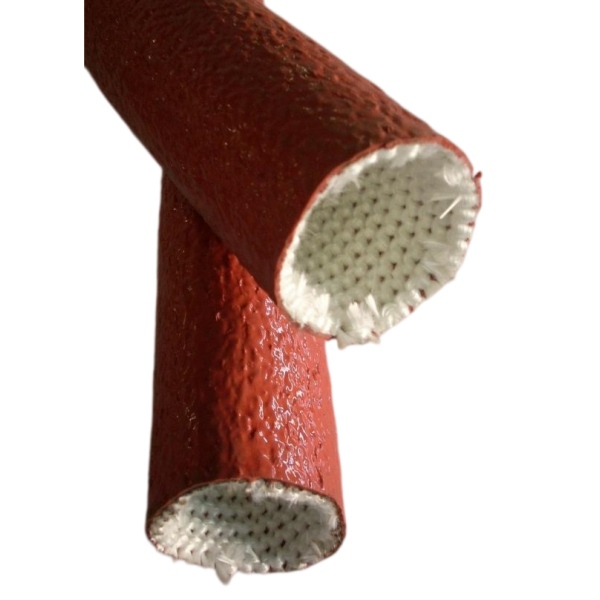
In a knitted fire sleeve, the yarn forms connected loops instead of the crossing pattern of a braid. Changes in loop geometry allow the textile to deform and follow the component beneath it. The knitted structure is one contributor to flexibility, not a complete specification for it.
The BSTFLEX knitted fire sleeve uses knitted fiberglass with a silicone rubber coating. It is an option to evaluate for assemblies where conformity and installation flexibility are important.
| Selection factor | Braided fire sleeve | Knitted fire sleeve |
|---|---|---|
| Fiberglass structure | Yarns interlaced around a tubular body. | Yarns formed into interconnected loops. |
| Product to evaluate | A tubular braid matched to the required dimensions and assembly process. | A looped substrate matched to the required conformity and routing. |
| Bending and handling | Evaluate the completed coating, wall and braid together; braided sleeves can be flexible. | Evaluate the completed coating, wall and knit together; the knit name alone does not establish bending performance. |
| Passing over fittings | Confirm usable ID and permitted expansion for the coated product. | Confirm usable ID and permitted expansion; do not assume unrestricted stretch. |
| Thermal performance | Use the selected product's rating and applicable test evidence. | Use the selected product's rating and applicable test evidence. |
| OEM production | Approve dimensions, cut length, installation sequence and batch requirements. | Approve the same requirements, including the condition in which length and diameter are measured. |
| Installation without end access | A conventional closed tube needs an accessible installation path. | A conventional closed tube also needs an accessible installation path. |
Use this comparison to shortlist samples. It is not a ranking of every braided and knitted firesleeve: different wall constructions and coatings can change the result.
Start with a braided fire sleeve when the project calls for a defined tubular construction and the protected assembly has repeatable dimensions. An OEM hose assembler, for example, can evaluate the EFRS range against the hose drawing, sleeve cut length and planned fitting-installation sequence.
Compare how the sample feeds along the hose, how it sits at bends and whether the finished ends remain in position. For a longer protected section, trial the intended length rather than approving the product from a short sample alone.
Braided construction is also the correct choice when it is explicitly required by an approved drawing or qualification. Do not substitute a knitted sleeve simply because its nominal ID and advertised temperature look similar. The substitution should be reviewed against the actual requirements.
Evaluate a knitted fire sleeve when the installation places particular demands on conformity. Examples include a hose routed around several components, a cable bundle with local changes in cross-section or an assembly where sleeve stiffness makes installation difficult.
Compare the knitted sample on the same assembly used for the braided trial. Observe whether it follows the route without excessive bunching, whether the coating remains intact and whether the required coverage is maintained after positioning.
For moving equipment, include the intended movement in the evaluation. A sleeve that is easy to bend by hand has not necessarily demonstrated acceptable performance through repeated service movement. Set the required test conditions from the equipment duty rather than treating initial softness as a durability result.
Two questions are often combined: will the sleeve bend around the route, and will it pass over the fitting? They require separate checks. A sleeve may follow a tight curve yet lack sufficient opening to pass a large connector.
Record the actual hose or bundle outside dimensions and the largest feature along the installation path. Check ferrules, nuts, connectors and elbows rather than assuming the hose body is the largest section.
For example, consider a hypothetical 25 mm hose with a 38 mm fitting. A nominal 29 mm sleeve should not be approved merely because it is knitted. Its usable opening and permitted expansion still need to accommodate the fitting without damaging the finished sleeve. Selecting a larger tube also requires checking the resulting fit along the smaller hose.
During new assembly production, fitting the sleeve before the obstructing end is assembled may resolve the issue. Follow the approved hose assembly process. For an installed line without usable end access, changing from braided to knitted does not remove the access problem.
An openable snap wrap firesleeve is a separate construction to evaluate in that situation. Its closed fit, seam coverage and thermal requirements must be checked independently.
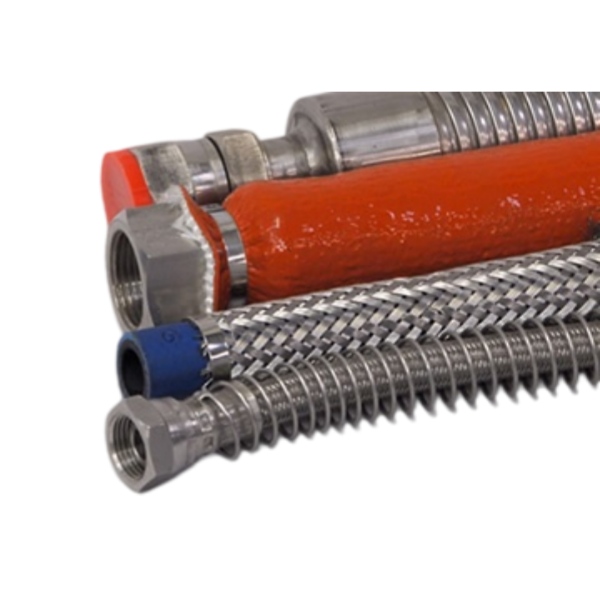
Not by definition. The published BSTFLEX braided EFRS and knitted product pages both identify a 260°C continuous-temperature upper limit. That shared catalog value does not make every aspect of their thermal or mechanical performance interchangeable.
Separate continuous service temperature from short-duration flame or molten-splash exposure. A peak exposure figure without its duration, test arrangement and acceptance criteria is not enough to compare two sleeves.
For a meaningful thermal comparison, define the heat source, exposure time, installed geometry and acceptable temperature at the protected component. Then request evidence applicable to the proposed sleeve construction. Do not estimate a temperature reduction from the words braided or knitted.
The hose, cable or fluid line also retains its own operating limits. Adding fire sleeve is not a basis for increasing the protected component's rated operating temperature.
A construction comparison should not become an unsupported claim that one sleeve is stronger in every respect. Specify the mechanical requirement: rubbing at a bracket, installation handling, repeated flexing and resistance to pulling are different questions.
Where abrasion matters, compare products under the same contact and movement conditions. Where fluid exposure matters, identify the actual fluid, temperature and contact duration. A general statement about oil resistance does not establish suitability for every hydraulic fluid, fuel or cleaning chemical.
Likewise, braided construction is not proof of aerospace approval, and knitted construction is not a universal industrial qualification. Treat a grade description as a prompt to request the relevant specification and evidence, not as the evidence itself.
Ask which product and construction were tested, which test method and edition were used, what installation was evaluated and what acceptance criteria applied. Confirm the scope before applying the result to another size, coating, closure or assembly.
Send one assembly drawing and one set of acceptance requirements for both candidates. This gives purchasing, engineering and production a common basis for comparison.
| Evaluation | What to record |
|---|---|
| Dimensions | Specified sleeve ID, usable fit, wall thickness, cut length, tolerances and measurement condition. |
| Installation | Assembly sequence, fitting passage, installation effort and coating condition afterward. |
| Finished routing | Coverage at the ends and bends, local folds and clearance from neighboring components. |
| Movement | Coverage and sleeve condition throughout the specified equipment movement. |
| Thermal requirements | Applicable exposure conditions, acceptance criteria and supporting product documentation. |
| Production supply | Approved construction, identification, packaging, inspection requirements and change-control agreement. |
Compare cost only after both candidates meet the required performance. Include installation time, cutting waste, packaging and inspection work alongside the price per meter. A cheaper sleeve that requires a different assembly process is not necessarily a lower-cost finished solution.
Retain the approved sample and part identification with the drawing. Future purchases should reference the accepted construction and specification, not simply silicone fire sleeve in the same color and diameter.
The fiberglass textile structure. Braided firesleeve uses interlaced yarns, while knitted firesleeve uses connected loops. The finished silicone coating, wall construction and dimensions also need to be included in the comparison.
No. A knitted substrate can offer useful conformity, but the completed sleeve must be compared. Bending flexibility, diameter expansion and behavior during repeated movement are separate performance requirements.
It can be considered as an alternative when the application allows it, but matching nominal size is not sufficient approval. Check installation, dimensions, thermal requirements and any drawing or qualification that specifies the existing construction.
Either may be appropriate when the selected product meets the assembly requirements. Start with the required protection, then compare routing, fitting clearance, movement and the production installation sequence.
First determine whether there is an accessible end and a viable path for a tubular sleeve. Without that access, evaluate an openable construction rather than expecting a different tubular textile structure to solve the problem.
Send BSTFLEX the hose or cable dimensions, largest fitting dimensions, protected length, routing drawing, heat exposure and required quantity. Include the installation stage and any specified test or approval requirements.
Use the braided fire sleeve and knitted fire sleeve product pages as starting points for sample selection. BSTFLEX can evaluate diameter, wall construction, cut-length, marking and packaging requirements against the proposed product.
Contact BSTFLEX for product data, sample evaluation or an OEM quotation. Specify both constructions when a side-by-side assembly trial is required.

 français
 Deutsch
 русский
 italiano
 español
 português
 Nederlands
 العربية
 日本語
日本語 한국의
한국의 Türkçe
 Polski
 Tiếng Việt
 slovenský
 Indonesia