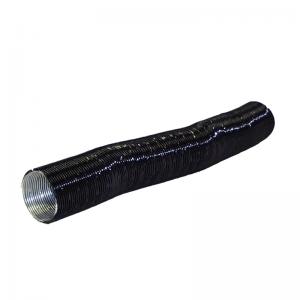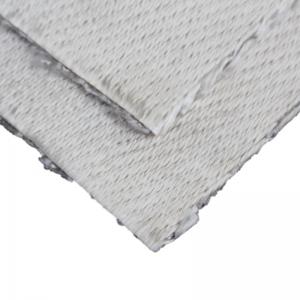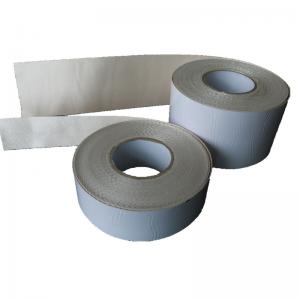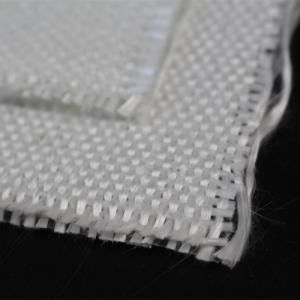
A purchase order that says only "polyester hose sleeve" leaves several decisions to the supplier: the textile construction, usable internal size, finished length and supply format. Those details determine whether the material reaches the assembly bench ready to use or needs additional sorting, cutting and fit checks.
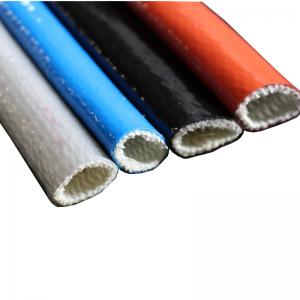
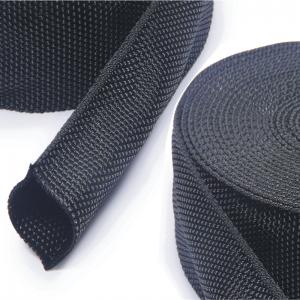
Polyester hydraulic hose sleeves are external textile covers selected to protect hose surfaces against abrasion. They are separate from the hose's pressure-containing construction. For an OEM hose assembly, specify the sleeve around the actual hose dimensions, installation sequence and wear conditions, then agree how it will be supplied and inspected.
The BSTFLEX polyester hydraulic hose protective sleeve provides a starting point for abrasion-focused sourcing. The following purchasing guide covers what to put on the enquiry, how to compare samples and which supply details to settle before production approval.
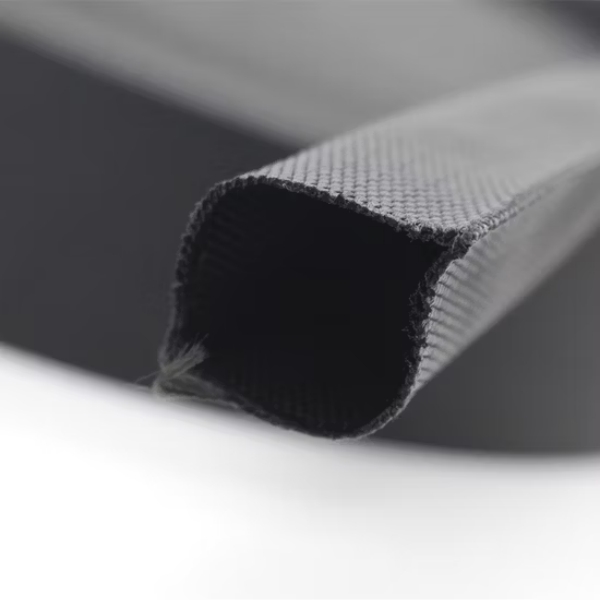
Use the outside dimensions of the finished hose. Nominal hose bore and dash size identify a different measurement; neither establishes the clearance needed inside the protective sleeve. Include the largest fitting profile that the sleeve must pass over when installation takes place after the fittings are attached.
For a bundle, supply its intended arrangement and overall outside profile. Do not calculate the required sleeve size simply by adding the hose diameters. Also confirm that grouping the hoses is appropriate for their movement and maintenance requirements.
| RFQ Dimension | Information to Provide or Confirm |
|---|---|
| Hose outside diameter | The finished hose OD and its tolerance or measured range, not only nominal bore. |
| Maximum fitting profile | The largest coupling, ferrule or other feature in the installation path. |
| Sleeve inside diameter or fit range | The supplier's usable internal size, measurement condition and recommended hose-fit range. |
| Lay-flat width | The width of the flattened tubular sleeve, with an agreed measurement method and tolerance. |
| Coverage and cut length | The protected section, end positions, finished cut length and acceptable length variation. |
| Wall thickness and clearance | The proposed sleeve thickness and available space at clamps, bends and adjacent components. |
This is an enquiry checklist, not a product size chart. Lay-flat width is not inside diameter, and neither should be substituted for hose OD. Confirm the fit range of the quoted construction and check a sample on the actual assembly. Dimensions from another sleeve series should not be transferred without confirming that the products are equivalent.
For a tubular polyester sleeve, determine whether it will be installed before or after the hose end fittings. Agree the sequence with the hose assembler, including access for crimping, pressure testing, identification and final inspection. The protective covering must not interfere with the approved hose-and-fitting assembly procedure.
A sleeve that fits the hose body may not pass over an assembled coupling. Conversely, selecting a much larger sleeve solely to clear a fitting may produce an unsuitable fit along the hose. Resolve that conflict during sample approval rather than leaving it to the production operator.
Where an existing installation has no practical end access, evaluate a removable construction separately. A wrap-around nylon hose sleeve uses a different installation method and material; it is not an interchangeable version of the polyester product.
Mark the required sleeve end positions on the assembly drawing. Maintain access to inspection points and required hose identification, and specify the end-retention method. Before fitting or inspecting protection on installed equipment, follow its shutdown, isolation and depressurization procedures, including control of stored energy.
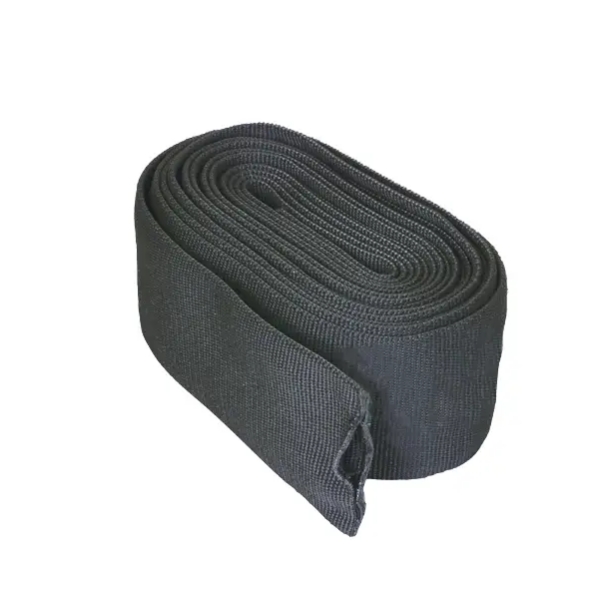
Describe the wear source before comparing materials. A hose rubbing against another hose, moving across a bracket and contacting a rough machine surface presents different evaluation conditions. Send photographs or a marked routing drawing showing where contact occurs and how the hose moves.
For sample comparisons, request the abrasion test method and edition, specimen construction, support arrangement, contact surface, applied load and endpoint. A cycle count without those details is not a complete purchasing specification. Results from different test methods or different sleeve constructions should not be treated as directly interchangeable.
Agree an acceptance criterion relevant to the application, then assess the proposed sleeve on a representative assembly. Observe coverage, movement, fit and local wear under an approved evaluation procedure. A laboratory abrasion result does not, by itself, establish a service-life guarantee for a machine operating in different conditions.
Correct unsuitable routing, sharp-edge contact and inadequate support rather than relying on a thicker cover to compensate. A polyester abrasion sleeve adds an external wear layer; it is not a structural hose support or a way to return a damaged hose to service.
Polyester identifies the fiber family, not the complete product specification. State the yarn or textile construction where required, together with thickness, any coating or finish, and the operating conditions. Do not assume that two sleeves with the same material name have the same fit or performance.
Provide normal and peak temperatures, exposure duration, nearby heat sources and expected contact with hydraulic fluids, cleaners or other chemicals. For chemical compatibility review, identify the substance, concentration, temperature and contact pattern. Confirm suitability for the supplied construction rather than relying on an unrestricted "chemical resistant" description.
When a project specifies flame resistance, review a flame-retardant polyester hose sleeve as a separate selection. For an MSHA-specified application, request the approval details covering the quoted product. Do not extend an approval from one sleeve grade to another.
Flame resistance and abrasion resistance do not establish burst containment or pinhole-leak protection. Those requirements need separate evidence for the relevant protective system. An external sleeve also does not increase the hose's rated working pressure or fluid-temperature limit.
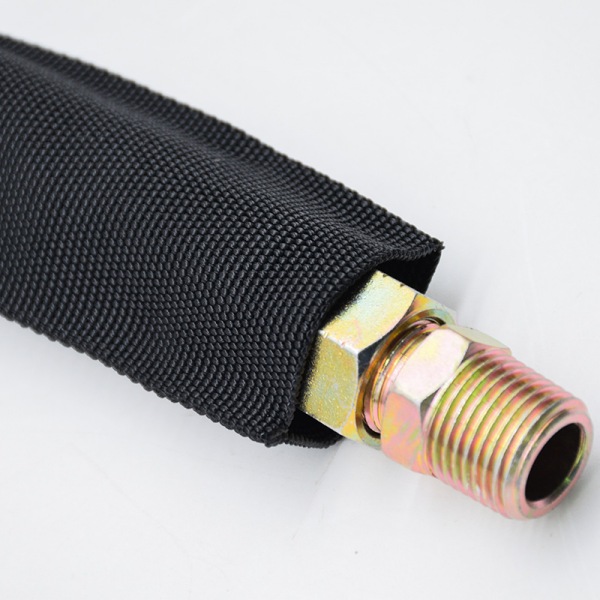
The lowest price per meter is not necessarily the lowest cost per installed piece. When requesting a polyester hose sleeve quotation, compare the formats below against your cutting facilities, part mix and assembly process. Availability and commercial conditions should be confirmed for the selected construction.
| Supply Format to Discuss | Purchasing Considerations |
|---|---|
| Roll supply | Suitable to evaluate when a workshop cuts several lengths from the same material. Specify roll length, minimum usable continuous length, any joint restrictions, labeling and the agreed cutting method. |
| Finished cut lengths | Useful to evaluate for repeat assembly lengths. Confirm finished length tolerance, edge treatment, pieces per pack and identification for similar-looking sizes. |
| Assembly-specific packs | Discuss when one equipment build needs several sleeve sizes or lengths. Define the pack contents, part numbers, quantities and packing sequence; confirm feasibility before ordering. |
For roll purchases, agree whether the stated length must be continuous and how short lengths are handled. For cut pieces, specify the finished dimension after the agreed edge treatment. Do not assume that every cut product is heat-sealed, or that one finishing method suits every construction.
Compare quotations on the same basis: usable material, cutting and finishing, waste, identification, packaging and assembly handling. State the sample quantity, initial order, expected repeat demand and delivery pattern separately. A forecast helps supply planning, but it should not be treated as a firm release quantity unless agreed.
Keep an approved sample together with its drawing revision and inspection requirements. Record the polyester construction, dimensions, measurement conditions, end finish and any marking or packaging details. Appearance alone is not enough to identify an equivalent replacement.
Check the first article on a representative hose assembly, including the relevant fitting profile and bends. Confirm that the sleeve can be installed as planned, covers the intended wear zone and does not interfere with clamps or inspection. Record the result before authorizing repeat production.
Agree how production lots will be identified and what incoming checks will be performed. Ask the supplier to notify you before changing the yarn construction, textile structure, coating, dimensions or finishing process. Define which changes need a new sample or renewed application evaluation.
BSTFLEX's OEM and custom manufacturing services include application review, sample development and production approval. Use that process to confirm the proposed polyester sleeve before fixing the purchasing specification. Minimum order quantity and lead time depend on the product and customization level.
Possibly, but verify the fit and installation path for each assembly. Hose outside diameter, fitting profile, protected length and routing can differ. Approve the shared size against every relevant drawing rather than relying on nominal hose bore alone.
No flame-resistance classification should be inferred from the word polyester. Specify the required performance and obtain documentation for the quoted construction. Keep standard abrasion sleeves and separately validated flame-retardant grades distinct.
Send the hose drawing or dimensions, fitting profile, protected length, wear conditions and proposed supply format. Include the checks the sample must pass. A sample with a clear evaluation purpose is more useful than an unqualified request for a standard sleeve.
For the BSTFLEX polyester protective hose sleeve, send your hose outside diameter, maximum fitting profile, coverage length, application conditions and any required tests. Add the requested roll or finished-piece format, quantities, packaging requirements and target delivery date.
Contact BSTFLEX with your hose assembly drawing or purchasing specification. For a machine requiring several types of external protection, use the hydraulic hose protection selection page to identify the appropriate product for each exposure.

 français
 Deutsch
 русский
 italiano
 español
 português
 Nederlands
 العربية
 日本語
日本語 한국의
한국의 Türkçe
 Polski
 Tiếng Việt
 slovenský
 Indonesia