Choosing heat resistant sewing thread for an industrial cover starts with the seam's job. An edge-binding seam holds a cut edge together. A closure seam is pulled whenever the jacket is opened. Stitching around a fixing strap must transfer the strap load into the fabric. These operations can require different thread sizes within the same finished product.
Para-aramid sewing thread offers high strength and low stretch for demanding fabric assemblies. For insulation jacket and thermal cover manufacturers, it is a material to evaluate where the seam needs mechanical strength together with heat resistance within the selected thread's operating range.
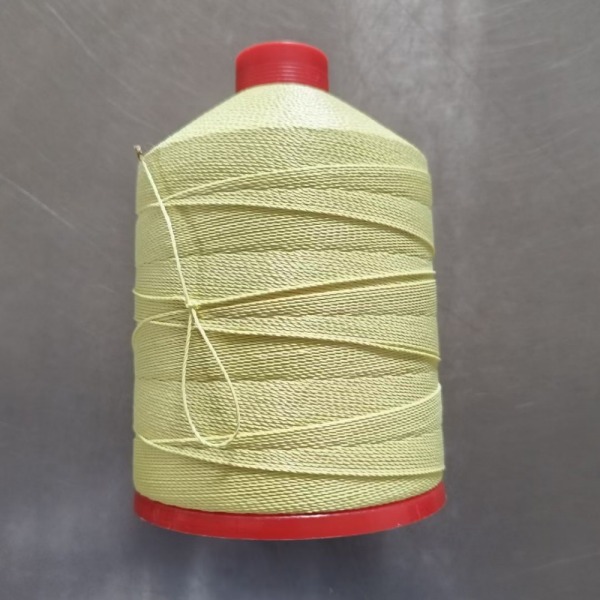
Para-aramid fibers combine high tensile strength with low elongation and non-melting behavior. These properties make the material relevant to technical textile seams where an ordinary sewing thread does not meet the design requirements.
Low stretch needs attention in the seam design. If a cover must stretch over a tight corner or accommodate movement, identify how that movement will be taken up by the fabric, seam geometry or closure. Give the supplier the expected movement as well as the required strength.
Also distinguish para-aramid thread from aramid-covered metal thread. One is a fiber thread; the other incorporates a metal core or reinforcement. Their specifications and behavior should be evaluated separately.
When selecting sewing thread for insulation blankets and industrial covers, mark the different seam functions on the drawing. This gives the sewing team a clearer starting point than specifying one heavy thread throughout the assembly.
| Sewing operation | What the sample should demonstrate |
|---|---|
| Binding and perimeter seams | Secure edge retention, acceptable stitch holes and a neat folded edge. |
| Overlap and closure seams | Consistent stitching through changing layer thickness and repeated opening. |
| Strap and fixing-point attachment | Load transfer through the complete attachment, including its reinforcement. |
| Layer-retention stitching | Stable layer positioning without unacceptable compression or distortion. |
For a removable jacket, include the areas that an installer grips or pulls during fitting. For a padded cover, include the compressed stack beneath the presser foot. Use the same outer fabric, backing and binding intended for production.
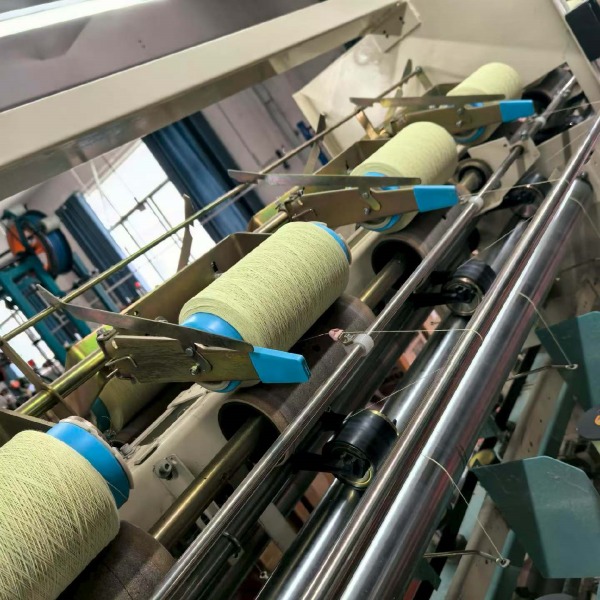
Anhui Parker's listed para-aramid sewing thread range includes Tex 40, Tex 60, Tex 70 and Tex 100. Natural yellow and black options are shown, with special sizes and packaging available on request. Confirm the current specification for the selected size and color when ordering.
Tex expresses thread mass in grams per 1,000 meters. A higher Tex number identifies a heavier thread, but it does not by itself establish the strength of the sewn joint.
Start with the seam performance you need, then compare suitable sizes on the actual fabric stack. Record stitch appearance, damage around needle holes and the way the sample responds to the intended load. A heavier thread should earn its place through the result of that comparison.
When reviewing strength data, distinguish the breaking force of a straight thread sample from the strength of a sewn assembly. The latter also depends on stitch formation, fabric strength, seam allowance and the way the load is applied.
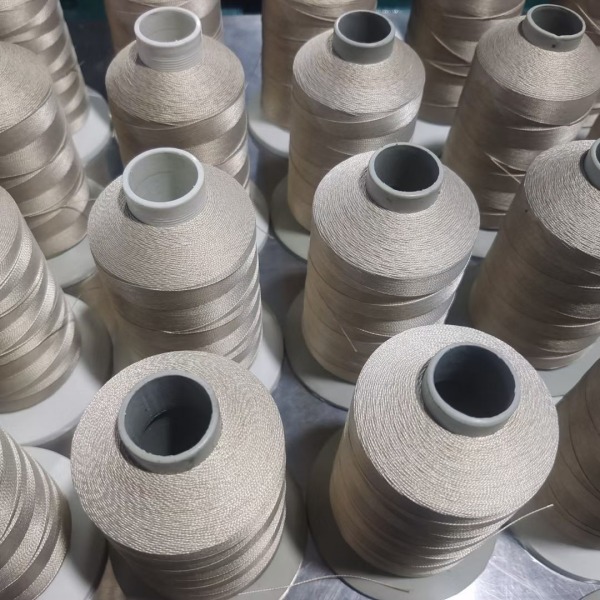
The linked para-aramid thread has a published working-temperature range of -40°C to +160°C. Use that product-specific range when screening applications. The temperature at the stitch line, exposure duration and mechanical load still need to be included in the final assessment.
Non-melting behavior should not be treated as permission to use the thread at any temperature. Sustained heat can affect material performance before visible destruction occurs. Ask for relevant heat-exposure data when the service conditions demand it.
Where a proposed seam is outside the selected aramid thread's working range, review another construction. Aramid-covered stainless steel sewing thread is a separate option for assessment. Its fiber covering and metal component require their own specification; approval should be based on the complete seam under the intended conditions.
Select a short trial piece that includes the hardest part of the sewing operation: a bound corner, an overlapping closure or a reinforced strap attachment. Keep an approved reference sample beside the machine so operators can compare the result consistently.
Record the thread size, needle system and size, stitch type, stitch length and machine settings. Inspect both sides of the seam and the fabric immediately beside it. If the intended product is repeatedly opened, include that handling in the evaluation.
Keep production and service observations separate. Sewing interruptions tell you about processing. A seam opening during a pull test tells you about the joint. A change after heat exposure tells you about performance under the conditioning used. Recording the actual failure makes the next adjustment more useful.
Once the sample is approved, put the selected thread construction and size on the purchase order. Include color, package format, quantity and any agreed test or inspection requirements. Retain the approved sample and identify the thread batch used to make it.
If the next order uses a different fabric coating, a thicker binding or a revised fastening design, check whether the approved seam still represents production. These changes are useful information for the thread supplier even when the finished cover keeps the same part number.
Choose the size from the required seam performance, fabric thickness and machine capability. The listed range includes Tex 40, 60, 70 and 100. Compare candidate sizes on the real assembly instead of assigning one size to every operation.
It can be evaluated as an alternative when the application needs its material properties. A change in fiber and elongation requires a sewing trial. Check stitch formation, fabric damage and the finished seam before approving the replacement.
No. The fabric, thread, insulation, closures and seam design all affect the finished cover. Any required fire performance must be established for the relevant assembly and test conditions.
Send Anhui Parker your fabric specification or a seam photograph, the number of layers, the function of the stitching and the expected operating conditions. Include your current thread size, machine details, required color and estimated order quantity.
Review the para-aramid sewing thread specifications to start a quotation or sample discussion. For projects involving several seam temperatures or material constructions, use the high temperature sewing thread range to identify the options to evaluate.

 français
 Deutsch
 русский
 italiano
 español
 português
 Nederlands
 العربية
 日本語
 한국의
 Türkçe
 Polski
 Tiếng Việt
 slovenský
 Indonesia