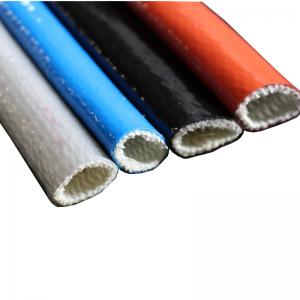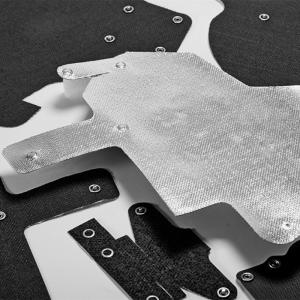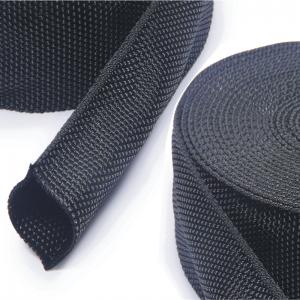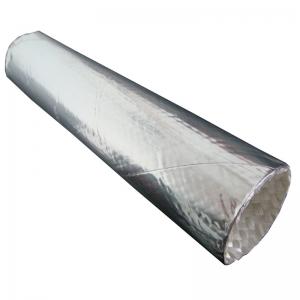
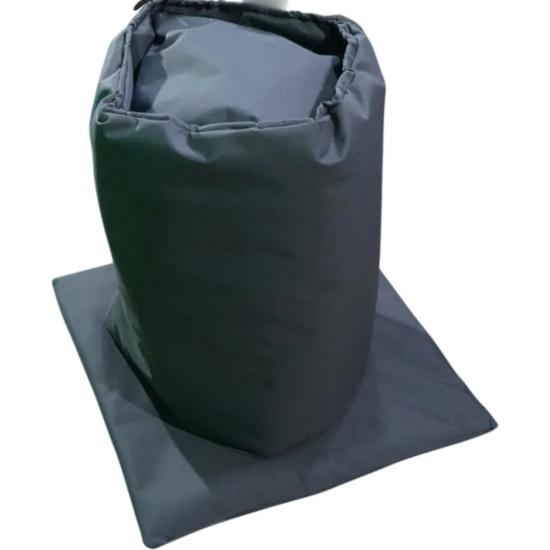
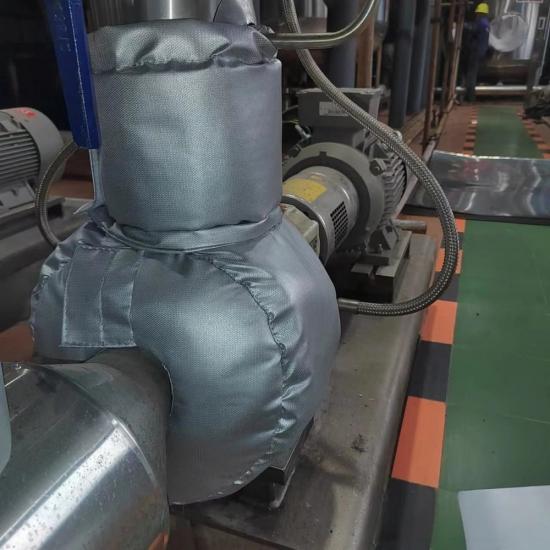
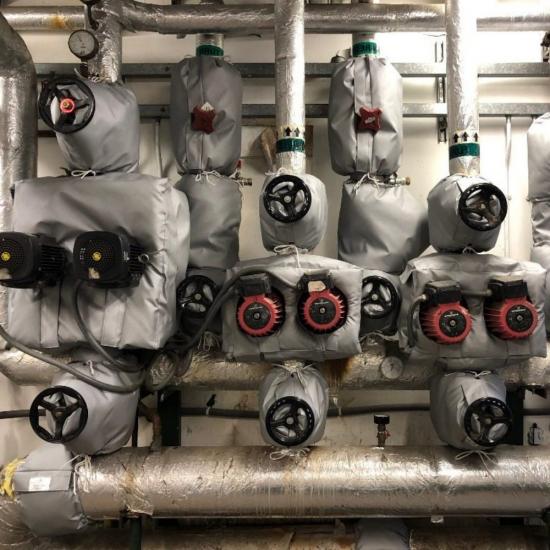
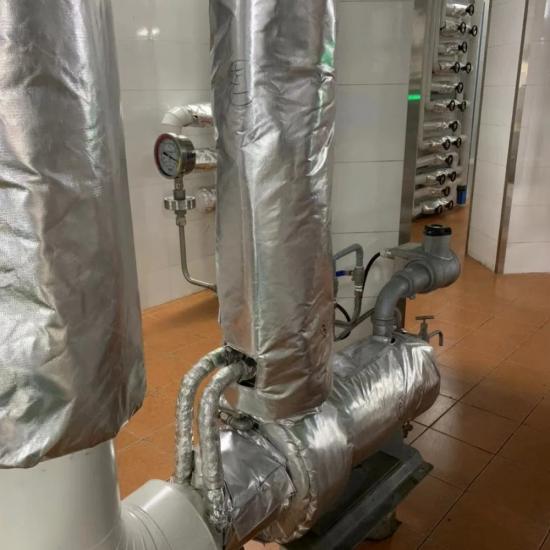
BSTFLEX removable pump insulation covers are custom-made for industrial pumps handling heated process media. Each reusable cover is patterned around the pump casing, suction and discharge connections, supports and service points, helping reduce exposed heat while keeping seals, bearings, couplings and other maintenance areas accessible.
order(moq):
1BSTFLEX manufactures removable pump insulation covers for industrial pumps carrying steam condensate, thermal oil, asphalt, resin, adhesives, chemicals and other temperature-sensitive process media. Each cover is made around the actual pump geometry, not selected from a general stock size.
The cover fits the insulated portion of the pump casing and associated connections while allowing planned access to seals, bearings, drains, vents, coupling areas and mounting points. A removable construction can be opened during maintenance and installed again without cutting away and rebuilding conventional insulation.
Pumps combine curved casings, flanged connections, support feet, shaft penetrations and nearby piping within a compact space. These features make rigid insulation difficult to fit and inconvenient to remove. Leaving the pump casing exposed, however, may create a break in an otherwise insulated process line.
A custom pump insulation jacket follows the equipment profile while separating the areas that must remain accessible. Depending on the pump and maintenance procedure, the finished system may use one wraparound cover or several numbered sections. Divided covers are useful when technicians need to remove the casing section without disturbing the insulation around the suction and discharge connections.
The insulation boundary must be confirmed before manufacturing. Electric motors, ventilation openings, coupling guards, bearing housings, mechanical seals and other heat-sensitive or moving components should not be covered unless the equipment manufacturer and project engineer have approved the arrangement.
Removable pump insulation covers are used where the pump casing operates above or below the surrounding temperature and must remain available for inspection. Common applications include:
This product is intended for industrial equipment insulation. It is not a domestic well-pump cover, swimming-pool pump enclosure, heat-pump sound blanket or self-heating freeze-protection bag. Applications requiring active heating must use a separately engineered heat-tracing or heating system.
The final layer system is selected according to the operating temperature, pump media, installation environment, available clearance and removal frequency. A typical removable pump insulation cover includes an outer protective layer, a thermal insulation core, a hot-face liner and reusable fastening hardware.
| Layer or Component | Typical Options | Design Purpose |
|---|---|---|
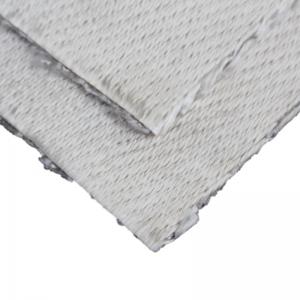
| Outer protective cover | Silicone coated fiberglass, PTFE coated fiberglass, aluminized fiberglass or other coated heat-resistant fabrics | Protects the insulation against handling, moisture, oil, weather and site contamination |
| Insulation core | Fiberglass needle mat, silica needle mat, ceramic fiber insulation or aerogel-based insulation | Provides the required thermal resistance within the permitted thickness |
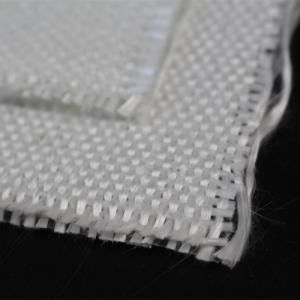
| Inner liner | Fiberglass fabric, silica fabric, stainless steel foil or stainless steel mesh | Contains the insulation and faces the hot equipment surface |
| Closures | D-rings and straps, stainless steel hooks, lacing wire, springs, buckles or other removable fasteners | Secures the shaped sections and permits repeated removal |
| Reinforcement | Quilting pins, stainless steel mesh, reinforced seams, edge protection and local wear patches | Maintains layer position around curved and irregular surfaces |
Temperature capability must be evaluated as a complete assembly. The fabric, insulation core, liner, sewing thread, fasteners and clearances all influence whether a construction is suitable for a particular pump.
A pump cover usually needs more pattern detail than a simple pipe or flange jacket. The casing may have different diameters on each side, and the motor-side opening must fit around the shaft or seal area without contacting moving parts. Drain plugs, vents, pressure connections and nameplates may also need to remain visible.
BSTFLEX can divide the cover into individual sections for the casing, suction connection and discharge connection. Overlapping flaps can reduce gaps between sections while allowing one part to be removed independently. Permanent labels can identify the equipment number, cover section and installation direction.
A dimensional drawing is preferred for a new pump insulation jacket. When a drawing is unavailable, photographs and field measurements can be used for preliminary pattern development. Please provide:
Photographs should show the pump from the front, back, both sides and above. Mark the intended insulation boundary directly on a photograph when there is any uncertainty about which components should remain outside the cover.
The closure arrangement depends on temperature, vibration, available space and how often the cover will be opened. D-rings and straps provide adjustable tension for many general industrial pumps. Stainless steel hooks, springs and lacing wire may be selected where an all-metal fastening system is preferred.
Closures should be positioned where maintenance personnel can reach them safely. They should not be placed against a wall, beneath the pump or next to rotating equipment. Reinforced pull tabs may be added to simplify handling when workers wear protective gloves.
The pump should be shut down and made safe according to the plant procedure before removing or installing the cover. After installation, confirm that the jacket does not restrict the shaft, coupling, cooling airflow, drain path or access required for routine checks.
During planned maintenance, inspect the cover for contaminated insulation, damaged seams, loose hardware and heat-related deterioration. A wet or chemically contaminated insulation core should be investigated rather than simply covered again. The pump and piping should also be checked for leakage before reinstallation.
Insulating an exposed pump casing can help reduce unwanted heat transfer between the process and the surrounding workspace. For heated media, the cover can support heat retention through the pump body. It can also reduce direct exposure to hot surfaces in occupied industrial areas.
The actual thermal result depends on surface temperature, ambient conditions, insulation type, thickness, coverage and installation quality. Where a specific external surface temperature or heat-loss value is required, provide the design conditions so the construction can be reviewed against the project target.
BSTFLEX supports prototypes, small project quantities and repeat OEM supply. Covers can be produced from engineering drawings, site measurements, cardboard or fabric templates, photographs or an approved physical sample. Part numbers, section labels, customer identification and packaging requirements can be incorporated for repeat programs.
For replacement work, explain why the previous cover is being replaced. A direct copy may not solve problems caused by incorrect clearances, inaccessible closures, contamination, excessive weight or an unsuitable insulation boundary. Photographs of the installed and removed cover help identify necessary design changes.
Normally, the cover is designed around the pump casing and approved hot sections rather than the electric motor. Motor ventilation, bearings, couplings, seals and moving components must remain clear unless the equipment manufacturer has approved another arrangement.
Only when the external geometry, connection positions and required access points are sufficiently similar. For reliable fit, each pump model or dimensional group should be reviewed separately.
Yes. The flanges may be incorporated into the main cover or insulated with separate removable flange covers. Separate sections usually provide more convenient access when only one connection requires maintenance.
Outdoor constructions are available with suitable outer fabrics, protected seams and drainage considerations. Weather resistance depends on the complete design, not only the fabric coating, so orientation and water-entry points must be reviewed.
Insulation slows heat transfer but does not create heat. Where freezing conditions are possible, the system may require correctly designed heat tracing or another active heat source in addition to the removable insulation cover.
Yes. Send an undamaged sample or a sample with the damaged areas clearly identified. Dimensional confirmation is still recommended because older covers may have stretched, shrunk or been altered during service.
Send the pump drawing, equipment model, operating temperature, quantity and photographs to BSTFLEX. We will review the insulation boundary, section layout, materials, fastening method and maintenance access before confirming the manufacturing specification.
Email: sales@pkfiresleeve.com
If you have questions or suggestions, please leave us a message,we will reply you as soon as we can!

 français
 Deutsch
 русский
 italiano
 español
 português
 Nederlands
 العربية
 日本語
日本語 한국의
한국의 Türkçe
 Polski
 Tiếng Việt
 slovenský
 Indonesia