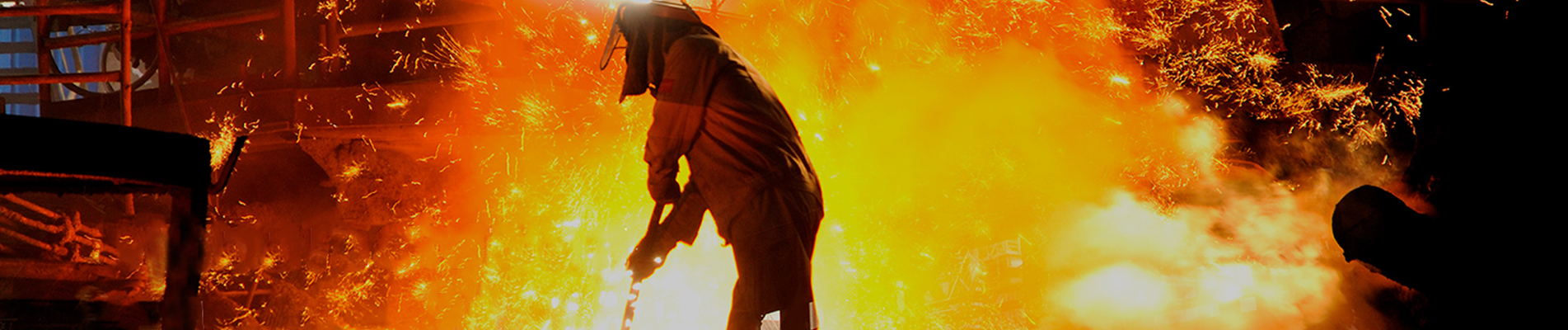
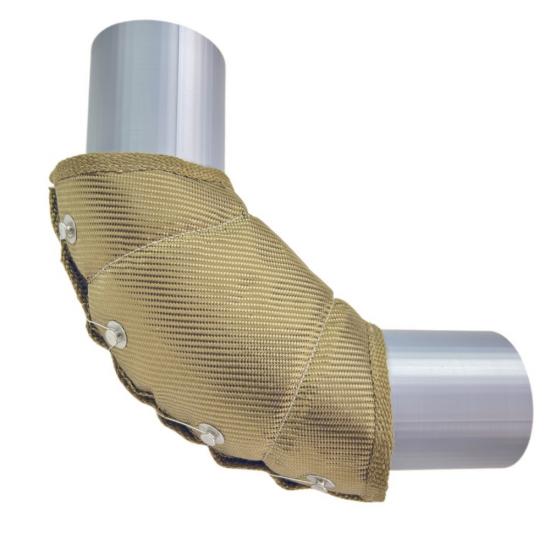
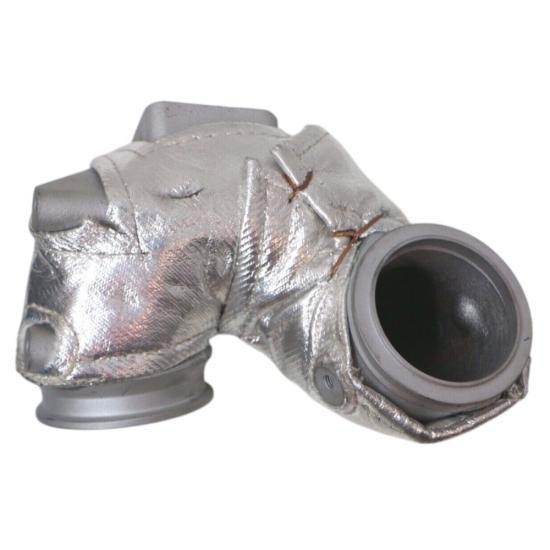
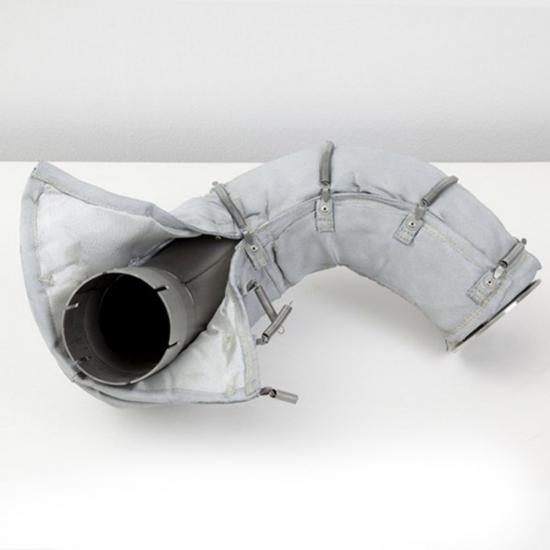
BSTFLEX removable elbow and pipe fitting insulation covers are custom-patterned for industrial bends, tees, reducers and other irregular piping components. Shaped reusable sections follow the fitting geometry, connect with adjacent pipe insulation and can be removed for inspection or maintenance without destroying the complete insulation system.
order(moq):
1Industrial pipe fittings interrupt the simple cylindrical shape of a straight pipe. Elbows change direction, tees create branches, and reducers join different pipe diameters. These changes make conventional insulation more difficult to cut, fit and remove without leaving gaps.
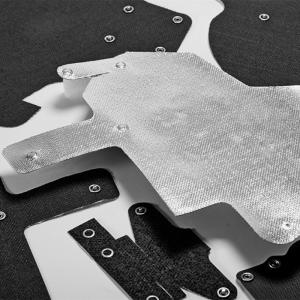
BSTFLEX manufactures removable insulation covers around the actual geometry of elbows, tees, reducers and related fittings. Each cover is patterned to meet the adjoining pipe insulation while preserving access to the fitting, welds and nearby components. The reusable construction can be removed during inspection or maintenance and installed again after the work is complete.
Flanges, valves, pumps and straight pipe sections have their own removable insulation products. Separating these components allows the fitting cover to follow the correct shape and permits maintenance teams to open only the section that needs service.
A flat rectangular blanket can wrinkle or pull away when wrapped around a curved elbow. At a tee, three pipe openings must align correctly. A reducer needs two different end diameters and a controlled transition between them. If the pattern does not match the fitting, the insulation may become compressed in one area and leave an open gap in another.
BSTFLEX uses shaped panels, segmented curves, reinforced seams and fitted openings to follow these profiles. Overlap flaps can connect the cover with adjacent straight-pipe jackets or permanent insulation. The objective is a practical removable assembly, not a loose sheet tied around an irregular component.
A segmented pattern follows the curve of a pipe elbow. The number and shape of the panels depend on the elbow angle, centreline radius, pipe diameter and insulation thickness. The closure can be positioned on the outside or inside of the bend according to available clearance.
A two-part or multi-part construction can be used when the elbow is close to a wall, floor or neighbouring line. Separate sections reduce the space required for installation and allow one side to be removed independently.
A tee cover includes openings for the main pipe and branch connection. Equal tees and reducing tees require different patterns. Branch angle, pipe diameters and the available straight length on all three sides must be confirmed.
A reducer jacket transitions between two pipe diameters. Concentric reducers are generally symmetrical around the centreline, while eccentric reducers require the flat side and installed orientation to be identified before the pattern is made.
Fabricated transitions, welded branch connections and non-standard fittings can be covered from a drawing, template, three-dimensional measurement or physical sample. Photographs from several angles help confirm installation clearance and closure position.
| Cover Component | Typical Options | Purpose |
|---|---|---|
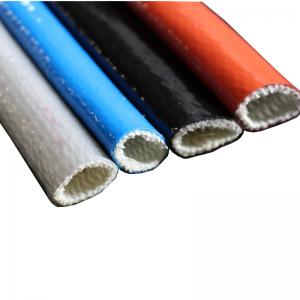
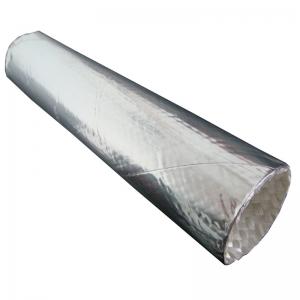
| Outer protective layer | Silicone coated fiberglass, PTFE coated fiberglass, aluminized fiberglass or other coated heat-resistant fabrics | Protects against handling, oil, moisture, weather, abrasion and site contamination |
| Insulation core | Fiberglass needle mat, silica needle mat, ceramic fiber insulation or aerogel-based insulation | Provides thermal resistance around the fitting |
| Hot-face liner | Fiberglass cloth, silica fabric, stainless steel foil or stainless steel mesh | Contains the insulation and faces the heated component |
| Fastening system | D-rings and straps, stainless steel hooks, springs, lacing wire, buckles or other reusable closures | Secures shaped panels and allows repeated opening |
| Reinforcement | Quilting pins, local wear patches, stainless steel mesh, reinforced seams and edge protection | Controls insulation movement around curved or branching shapes |
The complete cover must be designed around the application temperature. A material data-sheet temperature does not automatically become the rating of the finished product. Outer fabric, liner, insulation core, thread, fasteners, thickness and installation conditions must all be considered.
For a standard elbow, provide the following information:
If the centreline radius is unknown, send a square side-view photograph with a measuring scale and record the distance between the pipe centreline reference points. A drawing or physical template is recommended for non-standard fabricated bends.
For a tee, record the main pipe diameter, branch diameter, branch angle and centre-to-end dimensions in all directions. State whether the fitting is an equal tee or reducing tee. Include enough straight length for the cover to overlap adjacent insulation.
For a reducer, provide the large and small pipe diameters, overall reducer length and installed orientation. For an eccentric reducer, clearly identify whether the flat side is on the top, bottom or side. Photographs should show the reducer in its installed position.
The fitting cover should meet the adjoining insulation without forcing maintenance teams to remove an unnecessary length of pipe jacket. End flaps, drawcords, straps or shaped overlaps may be used depending on the pipe diameter, temperature and site preference.
When the adjacent pipe uses removable jackets, each component can receive its own identification number. When the adjoining pipe has permanent insulation and metal cladding, the fitting cover must be sized around the finished outside diameter rather than the bare pipe alone.
A well-designed cover must be removable in the space available around the fitting. The fastest closure is not useful if it faces a wall or another pipe. The project drawing or photographs should show the preferred opening direction and the space available for releasing straps, springs or lacing wire.
On horizontal outdoor piping, seams and overlaps should be positioned to discourage water entry. On vertical fittings, the design may require additional support so the insulation core and cover sections do not move downward during service.
After removal, keep the cover dry and avoid sharp folding that can damage or displace the insulation core. Before reinstallation, inspect the liner, seams, fasteners and shaped panels. A wet, contaminated or heavily compressed core should be evaluated before the cover is returned to service.
The fitting surface and weld areas should be inspected according to the facility maintenance plan. Removable insulation provides access, but it does not replace the owner's corrosion, leakage or mechanical-integrity program.
BSTFLEX can manufacture prototypes, project quantities and repeat OEM pipe-fitting covers. Production information can be developed from drawings, measurements, templates, photographs or an approved sample. Equipment numbers, line numbers, installation arrows, section labels and project packaging can be added for site identification.
When replacing an existing cover, state whether the original fitted correctly and identify any difficult closures, open gaps or interference points. Copying a worn sample without this information may reproduce the same installation problem.
Not reliably. Long-radius and short-radius elbows have different curves and overall dimensions. The correct radius or fitting dimensions should be confirmed before manufacturing.
No. The angle changes the panel geometry, end positions and closure arrangement. Separate patterns are required.
A separate tee cover is normally preferable. It follows the branch shape more accurately and allows the tee to be opened without removing long straight-pipe sections.
Yes. Provide the finished outside diameter of the existing insulation and cladding, not only the bare pipe diameter. The fitting cover can then be patterned with a suitable end overlap.
Yes, after the tracing layout, operating limits and access points are reviewed. Electrical connections and controls that require inspection must remain accessible.
Yes. A dimensioned drawing, template, three-dimensional measurement or physical sample can be used. Multiple photographs are recommended to confirm orientation and available installation space.
Send the pipe diameter, fitting type, angle, radius, dimensions, operating temperature, quantity and installation photographs to BSTFLEX. We will review the pattern, section layout, material construction, closures and connection to adjacent insulation.
Email: sales@pkfiresleeve.com
Previous:
Removable Pipe Insulation JacketNext:
Steam Trap Insulation JacketIf you have questions or suggestions, please leave us a message,we will reply you as soon as we can!

 français
 Deutsch
 русский
 italiano
 español
 português
 Nederlands
 العربية
 日本語
日本語 한국의
한국의 Türkçe
 Polski
 Tiếng Việt
 slovenský
 Indonesia